

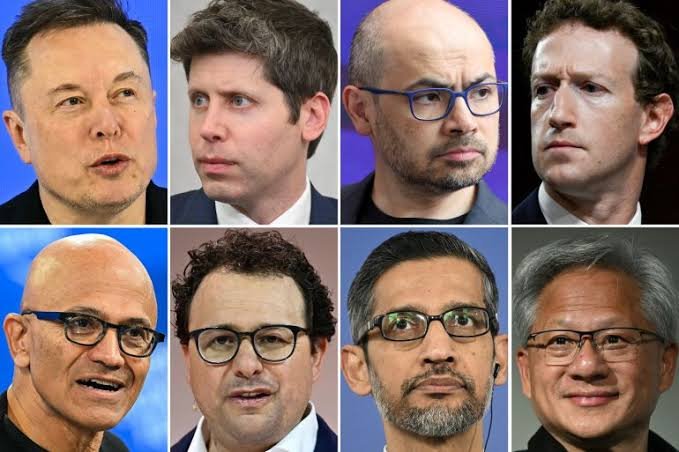
Artificial intelligence is no longer just a technology story. It has become a major business, economic and strategic force. A small group of technology leaders now plays an important role in shaping how AI is built, funded, used and regulated.
Among the most influential names are Sam Altman, Jensen Huang, Mark Zuckerberg, Dario Amodei and Demis Hassabis. Each leads a different company and follows a different AI strategy. Together, they help explain the changing AI power map.
What Is the New AI Power Map?
The new AI power map refers to the companies, executives, researchers and technology platforms that influence the direction of artificial intelligence.
The competition is not only about building the smartest AI model. It also involves:
- AI chips and computing power
- Large language models
- Data and research
- Cloud infrastructure
- Consumer products
- Open-source AI
- AI safety
- Business investment
- Global technology leadership
This makes the AI industry much broader than a simple race between chatbots.
Sam Altman: Building AI for Everyone
Sam Altman is one of the most recognizable figures in modern AI. As CEO of OpenAI, he has helped turn generative AI into a mainstream technology.
OpenAI became widely known through ChatGPT, which introduced millions of people to conversational AI. Under Altman’s leadership, the company has focused on developing increasingly capable AI systems and making them available through consumer and business products.
Altman’s strategy is largely centered on AI adoption at scale. The goal is not simply to build advanced models but to integrate AI into everyday work, education, software development and other industries.
His influence also extends to the infrastructure needed to operate advanced AI systems. Training and running powerful models requires enormous computing resources, making partnerships, chips and data centers important parts of the AI economy.
Jensen Huang: The Power Behind AI Computing
Jensen Huang occupies a different position on the AI power map.
As CEO of NVIDIA, Huang leads the company whose graphics processors and AI computing platforms have become central to modern AI development.
AI models require huge amounts of computing power. NVIDIA’s GPUs have become widely used for training and running sophisticated AI systems.
This gives Huang a unique position. While executives such as Altman focus heavily on AI applications and models, Huang is closely connected to the hardware and infrastructure layer.
His vision extends beyond individual chips. NVIDIA is building a broader computing ecosystem involving processors, networking, software and data-center technologies.
In simple terms, if AI companies are building the intelligence, NVIDIA is one of the key companies providing the computing infrastructure that allows that intelligence to operate.
Mark Zuckerberg: Meta’s Open AI Strategy
Mark Zuckerberg represents another important approach.
Through Meta, Zuckerberg has invested heavily in AI research, computing infrastructure and AI-powered products. Meta has also promoted open approaches to AI through its Llama family of models.
This strategy is significant because it challenges the idea that the most powerful AI systems must always remain completely closed.
Meta can use AI across its huge consumer platforms, including social networking, messaging and digital advertising. AI can help improve recommendations, advertising systems, content tools and user experiences.
Zuckerberg’s position therefore combines AI research, open models and massive consumer distribution.
Dario Amodei: AI Safety and Frontier Models
Dario Amodei is another major figure in the frontier AI race.
As CEO of Anthropic, Amodei has helped develop Claude, a family of AI models designed for advanced reasoning, writing, coding and business applications.
Anthropic has placed strong emphasis on AI safety and responsible development. Its approach reflects a belief that increasingly capable AI systems need careful testing, safeguards and oversight.
Amodei’s influence is especially important because the AI industry is moving toward more powerful systems that can perform increasingly complex tasks.
Anthropic competes directly in the frontier-model market while maintaining a strong public focus on AI safety.
Demis Hassabis: AI Research and Scientific Discovery
Demis Hassabis brings a research-driven perspective to the AI power map.
As the leader of Google DeepMind, Hassabis has been associated with some of the industry’s most important AI research achievements.
DeepMind’s work has expanded beyond traditional chatbots into areas such as science, biology, mathematics and advanced AI research.
One of the most important parts of Hassabis’s strategy is the connection between AI and scientific discovery. AI can potentially help researchers understand complex biological systems, discover new materials and accelerate scientific work.
With Google’s enormous infrastructure and research resources behind it, DeepMind occupies a powerful position in the global AI ecosystem.
How These Five Leaders Compare
The easiest way to understand the new AI power map is to look at their different strengths.
| Leader | Company | Major AI Focus |
| Sam Altman | OpenAI | Frontier AI and mass adoption |
| Jensen Huang | NVIDIA | AI chips and computing infrastructure |
| Mark Zuckerberg | Meta | Open AI models and consumer AI |
| Dario Amodei | Anthropic | Frontier models and AI safety |
| Demis Hassabis | Google DeepMind | AI research and scientific discovery |
These leaders are not competing in exactly the same category. Their influence comes from different parts of the AI ecosystem.
Why the AI Power Map Matters
The AI industry is becoming an interconnected system.
A powerful AI model needs computing infrastructure. Computing infrastructure needs chips and data centers. AI companies need users and businesses. Research organizations need capital and talent.
This means the future of AI could be shaped by cooperation as much as competition.
The biggest question is no longer simply “Who has the best AI?”
It is increasingly:
Who controls the models, chips, infrastructure, research, distribution and capital needed to build the next generation of AI?
The answer may change rapidly as new technologies emerge.
The Future of AI Leadership
Sam Altman, Jensen Huang, Mark Zuckerberg, Dario Amodei and Demis Hassabis represent five different forms of influence in artificial intelligence.
Altman represents large-scale AI adoption. Huang represents computing power. Zuckerberg represents consumer platforms and open models. Amodei represents frontier AI with a strong safety focus. Hassabis represents advanced research and scientific applications.
Their strategies are different, but their combined influence shows why AI has become one of the most important technology stories of the decade.
The new AI power map will continue to evolve as companies invest billions in infrastructure, models, research and products. For businesses, governments and consumers, understanding these leaders provides a useful way to understand where the AI industry may be heading next.
