

[ad_1]
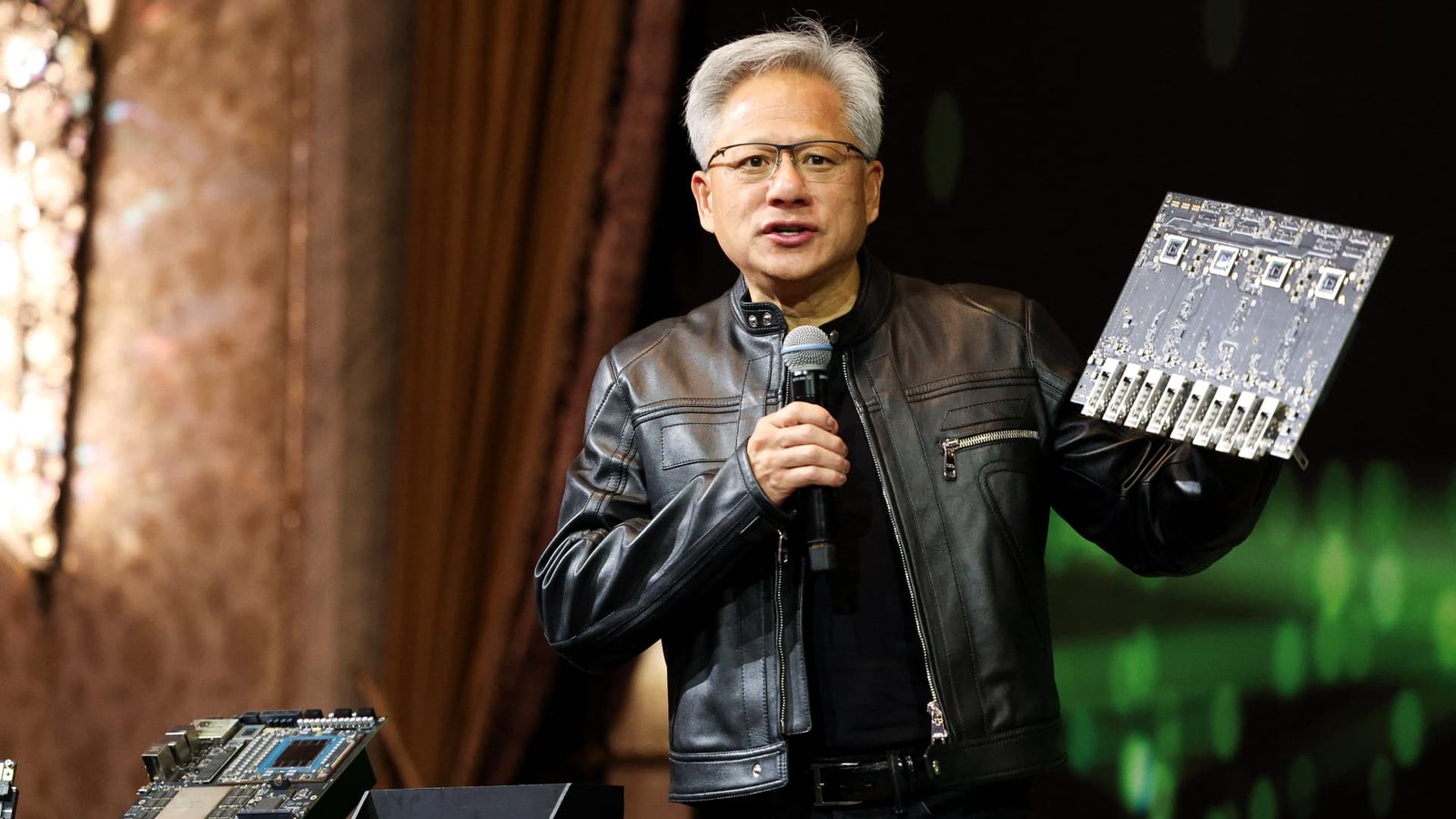
Jensen Huang, co-founder and CEO of Nvidia Corp., speaks during a news conference in Taipei on May 21, 2025. Cheng / AFP) (Photo by I-HWA CHENG/AFP via Getty Images)
I-hwa Cheng | Afp | Getty Images
When Nvidia CEO Jensen Huang appeared at Computex in Taipei last week, his presence dominated headlines. But it wasn’t his keynote that drew political attention — it was what he said after the speech.
In interviews on the sidelines of the event, Huang sharply criticized U.S. export controls on AI chips, calling them a “failure.” He blamed both the Trump and Biden administrations for triggering a collapse in Nvidia’s China business, claiming that the company’s market share in the country dropped from 95% to 50% over four years, and disclosed a multi-billion dollar write-down on unsold H20 chips blocked from sale. Huang further argued that these restrictions have only pushed Chinese firms to innovate faster, intensifying competition.
The Nvidia CEO’s complaints about U.S. policy continued after Wednesday’s earnings report, with Huang saying China is “effectively closed.”
“Export restrictions spurred China’s innovation,” Huang said during the earnings call. “The U.S. has based its policy on the assumption that China cannot make AI chips. Assumption was always questionable. Now it’s clearly wrong.”
“The question is not whether China will have AI. It already does,” he added.
On Wednesday, Chinese generative AI company DeepSeek, whose debut was the watershed moment in China’s arrival as a competitor to the best the U.S. has to offer in the AI race, released a new model.
While Huang’s frustrations may resonate with some in the business world, they badly miss the strategic mark. The semiconductor policies Huang criticizes were never designed to protect Nvidia’s commercial interests in China. They were, and remain, about U.S. national security.
The Biden administration’s controls, building on Trump-era efforts, reflect a sober reality: the U.S. cannot afford to fuel the military rise of its chief strategic rival. Advanced chips power the modernization of the People’s Liberation Army, including command, control, communications, computers, intelligence, surveillance, and reconnaissance (C4ISR) systems. These restrictions are not about quarterly earnings — they are about avoiding scenarios where American troops face U.S.-designed technology on the battlefield.
Critics like Huang claim these controls have backfired, accelerating China’s tech independence. But that effort didn’t begin with the 2022 restrictions. It was formalized years earlier through the “Made in China 2025” strategy, approved by the State Council in 2015. With over $150 billion in state support, China’s chip sector has long aimed to reduce dependence on foreign suppliers. The controls didn’t start this race; they were a response to it.

In an interview with CNBC’s Jim Cramer on “Mad Money” on Wednesday, Huang said 50% of the world’s AI developers are in China and “we want the world to build on America’s IT stack. … that’s the most important strategic reason to be in China.”
But as China continues to race against the U.S. in AI, it should not be done by exploiting the U.S. or with U.S. companies willingly helping it. Furthermore, China is making its own decisions regardless of U.S. export controls to favor its own companies, a goal it had well before the Trump or Biden export controls. This may be inconvenient history, but it is history, nonetheless.
China’s innovation model is evolving. While foreign technology transfer and joint ventures played early roles, Chinese firms now combine global know-how with massive capital, targeted industrial policy, and relentless domestic competition. China ranks second in global R&D spending and leads in green tech, EVs, and high-speed rail. It extracts what it can from foreign firms, and then moves on. The U.S. must safeguard leading-edge technologies and delay diffusion for as long as possible. This is not a permanent advantage, but it is a necessary one.
Look at sectors where the U.S. failed to act — solar panels, EV batteries, telecom. In each case, China leapfrogged the West and locked in global dominance. But contrast that with aviation, where the U.S. has maintained strict export controls and upheld a high regulatory bar. China’s COMAC, although making noteworthy gains, remains far behind Boeing and Airbus in capability, global market access, safety certifications, and production reliability. Where the U.S. held the line, it held its lead.
Nvidia’s arc in China follows a familiar pattern. Foreign firms are welcomed, dominate temporarily, and are ultimately displaced. We all know the story by now — Apple, Tesla, Starbucks — all have faced this trajectory. Huang’s claim that U.S. policy ended Nvidia’s privileged market position ignores this well-established history. The displacement for Nvidia (like for so many others) was coming either way. And despite his warnings, Nvidia has not suffered a collapse. In 2022, Huang warned that export controls could devastate his company. Since then, Nvidia’s stock has increased more than tenfold. In fiscal year 2024, its data center revenue jumped 217% year-over-year, driven by soaring demand across the U.S., Europe, and Gulf States.
The company’s success has continued — despite, or perhaps partially because of, the strategic shift in its market exposure. Its latest results showed overall revenue grew by 69% during the quarter, and in its key data center division — which includes AI chips and related parts — growth was 73% on an annual basis to $39.1 billion. Huang said in an earnings statement that “global demand” continues to be “incredibly strong” for its AI equipment.
The real risk is not that these policies have failed — they haven’t, when judged against their national security goals. The risk is that their momentum could be disrupted by policy discontinuity, political lobbying, or shifting priorities in Washington. We’ve already seen the Trump administration roll back one key element: the Biden-era AI diffusion rule. That rule, with a tiered structure aimed at controlling the spread of high-performance chips and AI model weights based on risk level, would have required global licensing and compliance from chipmakers like Nvidia. Its rescission — prompted by commercial and legal concerns — has raised alarms among national security officials. Other export controls, however, remain firmly in place.
Nvidia should be using its success around the world to work hard to compete against China in other markets and stop focusing on its diminishing market share in China, especially after Trump gave the company the gift of repelling the AI diffusion rule.
Huang may have intended his remarks to influence the policy debate. Instead, they triggered political reaffirmation. In fact, his comments may go down as his “Jack Ma moment” — a high-profile critique swiftly followed by a government response that reasserts authority. Just as Ma’s critique of Chinese regulators at the Bund Summit preceded the abrupt suspension of Ant Financial’s IPO, Huang’s criticism on the margins of Computex was quickly answered. Trump advisor Sriram Krishnan said in an interview with Bloomberg, “the guardrails are staying,” emphasizing that AI chips “can be used in ways that fundamentally challenge U.S. national security.”
On Wednesday, before Nvidia had even reported, shares of chip design companies Cadence and Synopsys sank after the Financial Times reported that the White House told them to stop selling to clients in China.
U.S. semiconductor policy isn’t about one firm’s earnings or market access — it’s about protecting America’s strategic edge in a high-stakes geopolitical contest. The challenge ahead is not to protect any one company’s dominance in China. It’s to defend the foundational technologies that define the future of power. Sometimes that means stepping back from markets that were never going to remain open anyway.
This is the hard truth of policymaking. Not every decision, few in fact, is about corporate profits. Most are about the safety, security, and long-term stability and strength of the country, and the people who protect it.
—By Dewardric McNeal, Managing Director and Senior Policy Analyst at Longview Global, and a CNBC Contributor
[ad_2]
Source link
