

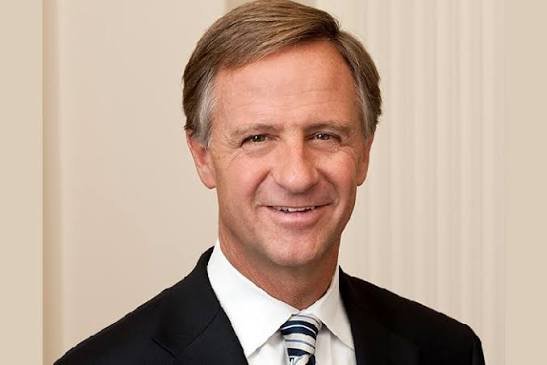
Bill Haslam is an American businessman, civic leader, and former governor of Tennessee. A member of the Republican Party, he served as the 49th Governor of Tennessee from 2011 to 2019. Before entering politics, Haslam built a successful career in business and became known for his work in education, economic development, and public service.
His time as governor focused on job creation, improving education, strengthening Tennessee’s economy, and making the state more attractive to businesses. After leaving office, Haslam continued his work in business, education, philanthropy, and civic life.
Who Is Bill Haslam?
Bill Haslam is a businessman and former Governor of Tennessee who served two terms from 2011 to 2019. He was born on August 23, 1958, in Knoxville, Tennessee.
Haslam comes from a well-known Tennessee business family. His father, Jim Haslam, founded the Pilot Corporation, which grew into a major company in the travel-center and fuel industry. Bill Haslam later developed his own business career and became involved in public service.
Before becoming governor, Haslam served as the mayor of Knoxville from 2003 to 2011. His experience as a mayor helped prepare him for statewide leadership.
Bill Haslam’s Career Before Becoming Governor
Haslam’s professional background was mainly in business. He worked in the family business and later became involved in several business ventures.
His business experience gave him an understanding of areas such as employment, investment, customer service, and economic development. These experiences later became important parts of his political message.
In 2003, Haslam was elected mayor of Knoxville. He won re-election in 2007 and served as mayor until 2011.
As mayor, he worked on economic development, downtown improvements, public safety, and community projects. His performance in Knoxville helped establish his reputation as a business-oriented Republican leader.
Bill Haslam Becomes Governor of Tennessee
In 2010, Haslam ran for governor of Tennessee. He won the election and took office on January 15, 2011.
He was re-elected in 2014, giving him two consecutive terms. Tennessee’s constitution limited governors to two four-year terms, so Haslam left office in January 2019.
During his eight years as governor, Haslam promoted policies focused on economic growth, education, workforce development, and government efficiency.
Major Achievements as Governor
1. Focus on Job Creation
One of Haslam’s major priorities was attracting new businesses and encouraging existing companies to expand in Tennessee.
His administration promoted Tennessee as a business-friendly state. Economic development efforts targeted manufacturing, technology, logistics, and other industries.
Tennessee attracted significant corporate investment during his time in office, helping strengthen the state’s reputation as a location for business expansion.
2. Education Reform
Education was one of the central themes of Haslam’s administration.
He supported programs designed to improve Tennessee’s schools and increase access to higher education. One of his best-known initiatives was Tennessee Promise, a program that provides eligible students with the opportunity to attend community or technical college tuition-free after completing certain requirements.
The program attracted national attention and became an important part of Tennessee’s education policy.
3. Workforce Development
Haslam also focused on preparing workers for jobs that required specialized skills.
His administration promoted workforce-training programs and partnerships between colleges, technical schools, and businesses. The goal was to help students develop practical skills that matched the needs of Tennessee employers.
This approach connected education policy directly with economic development.
4. Tennessee’s Economic Growth
During Haslam’s tenure, Tennessee continued to develop as a major center for manufacturing, logistics, healthcare, and business services.
Companies expanded operations in the state, while communities worked to attract new investment.
Haslam frequently presented economic development and workforce preparation as connected goals: attracting companies was important, but having a skilled workforce was equally important.
5. Healthcare and Policy Debates
Healthcare was another major issue during Haslam’s governorship.
One of the most debated decisions involved whether Tennessee should expand Medicaid under the Affordable Care Act. Haslam proposed a plan known as Insure Tennessee, but the proposal faced strong opposition in the state legislature and was not implemented.
The issue demonstrated the political challenges Haslam faced even while pursuing policies that sometimes differed from members of his own party.
Bill Haslam’s Leadership Style
Haslam generally presented himself as a pragmatic, business-minded Republican.
Rather than focusing only on traditional political issues, he often emphasized:
- Economic development
- Education
- Workforce training
- Government efficiency
- Infrastructure
- Long-term economic growth
His business background influenced his approach to government. He often promoted cooperation between government, schools, and private companies.
Life After Politics
Bill Haslam left the governor’s office in January 2019 after completing his second term.
Since then, he has remained active in business, education, philanthropy, and public affairs.
He has also been involved with the University of Tennessee and other civic and educational organizations. His family has continued to have a strong presence in Tennessee business and philanthropy.
Haslam has also remained a prominent voice on leadership, public policy, education, and civic responsibility.
Bill Haslam’s Legacy
Bill Haslam’s legacy as governor is closely connected to education reform, economic development, and workforce preparation.
Programs such as Tennessee Promise helped make his administration particularly notable in the education field. His economic policies also contributed to Tennessee’s reputation as a business-friendly state.
At the same time, some of his policy decisions generated debate, especially around healthcare and the role of government.
Overall, Haslam’s career represents a combination of business, local government, statewide leadership, education advocacy, and philanthropy.
Conclusion
Bill Haslam’s career is an example of how business experience can lead to public leadership. From his work in Tennessee business to his eight years as Knoxville’s mayor and then governor, he built a long career around economic development and public service.
As Governor of Tennessee, his major focus areas included job creation, education, workforce development, and economic growth. After leaving political office, he continued working in education, business, philanthropy, and civic affairs. His influence on Tennessee remains especially visible through education and workforce initiatives developed during his administration.
