

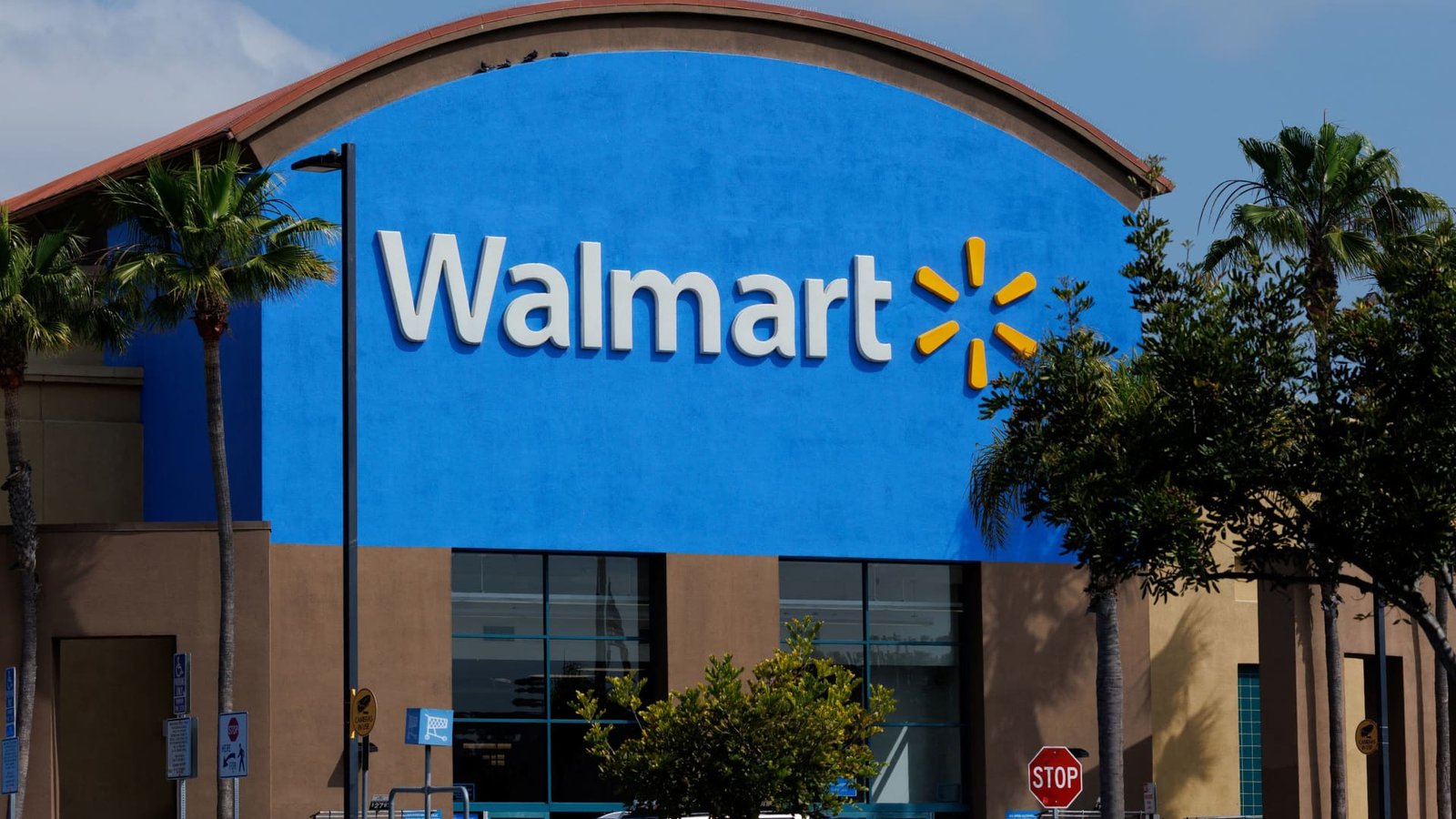
A Walmart store is shown in Oceanside, California, U.S., May 15, 2025.
Mike Blake | Reuters
Last month, Walmart downplayed how much President Donald Trump‘s tariffs would affect its business in front of a large audience of investors. CEO Doug McMillon pointed to other challenging times that the company had weathered — like the aftermath of 9/11 — and the CEO of its international business didn’t even bring up trade during a panel with global corporate leaders.
The largest U.S. retailer struck a much different tone Thursday. On its earnings call and in CNBC interviews about its quarterly results, the company warned that higher duties on imports would soon mean higher prices for its shoppers.
“We’re pleased with the progress that’s been made by the [Trump] administration on tariffs from the levels that were announced in early April, but they’re still too high,” CFO John David Rainey told CNBC in an interview.
He added that Walmart is “wired for everyday low prices, but the magnitude of these increases is more than any retailer can absorb.”
The discounter’s remarks came with a risk considering Trump’s history of publicly attacking other companies or people perceived to oppose his agenda. Sure enough, he lashed out at Walmart in a weekend social media post, telling the company to “EAT THE TARIFFS.”
Walmart’s shift in tone about the impact of tariffs — and the back-and-forth with the White House — is the latest illustration of the delicate dance of business leaders trying to appease customers, shareholders and a notoriously transactional White House as Trump’s ever-changing trade policy roils their businesses. But the discounter’s more outspoken response also highlights an area where corporate leaders have grown more willing to publicly criticize Trump’s policy positions.
“Tariffs are really the only topic that has broken through a really silent stretch of corporate engagement,” said Joanna Piacenza, vice president of thought leadership at Gravity Research, a Washington, D.C.-based firm that helps corporations navigate reputational risk and counts Fortune 500 companies as its clients. “It is an issue that corporations, that CEOs feel comfortable speaking out on because they’re tying it to business issue. That can’t necessarily be said about other polarizing issues that are dominating the zeitgeist right now.”
Walmart responded to Trump with its own statement, echoing its commitment to maintain low prices.
“We have always worked to keep our prices as low as possible and we won’t stop,” Walmart said. “We’ll keep prices as low as we can for as long as we can given the reality of small retail margins.”
Walmart declined to comment beyond its statement. A source close to the company said Walmart’s decision to warn of higher prices was motivated by a sense of obligation to explain to customers and investors why prices would increase.

While Walmart’s prices are closely watched due to its massive reach, it hasn’t been alone: other companies including Microsoft and Subaru have warned of price increases related to tariffs. But on Tuesday, Home Depot broke with that pattern, as its CFO Richard McPhail said the company plans to “generally maintain our current pricing levels across our portfolio.”
Consumers and investors will get a clearer read on how companies will handle pricing in the coming days, as Target and Lowe’s, among others, will post first-quarter results.
Shifting winds
As Trump prepared to take office, the corporate world welcomed him by contributing to a record $239 million haul for his inauguration committee. Those funds included donations from the National Retail Federation, the industry’s lobbying arm, and big-box giant Target, which contributed to the inauguration committee for the first time in at least a decade. The NRF gave $250,000 to the fund, while Target wrote a check for $1 million.
Walmart also contributed $150,000 to the inaugural committee for Trump, consistent with the Arkansas-based retailer’s donations for the past three presidential inaugurations — including former President Joe Biden’s in 2021 and Trump’s first in 2017.
Walmart, Target and a range of other corporations also followed Trump’s lead in rolling back or scrapping major diversity, equity and inclusion programs. Businesses, buoyed by hopes that Trump would cut their taxes, stayed mostly quiet about the president’s policies for the first two months of his administration.
But then the tariffs came. More companies spoke out about the U.S. duties after April 9 than in the immediate wake of Trump’s April 2 announcement that he would impose steep trade barriers on dozens of countries, according to data from Gravity Research. April 9 was the day Trump temporarily reduced those steep retaliatory levies but hiked tariffs on Chinese imports to an astronomical 145%.
There were 139 corporate responses to tariffs on channels including press releases, earnings calls, social media, media interviews and employee memos from April 10 to April 25, up from 79 between April 2 and April 9, Gravity Research found. Nearly half of those tracked statements by corporations since the temporary tariff reprieve came from earnings calls where CEOs delivered prepared remarks and answered analysts’ questions.
U.S. President Donald Trump holds a law enforcement event in the Oval Office of the White House in Washington, D.C., May 19, 2025.
Kevin Lamarque | Reuters
The backlash to tariffs picked up steam from some top executives who had lauded Trump’s policies as a boon for business only months earlier. The chief executive officers of Delta Air Lines and JPMorgan Chase, companies that each gave $1 million to Trump’s inauguration fund, both spoke out about how tariffs were hurting U.S. consumer spending.
Hours before the president suspended some duties that day, JPMorgan Chase CEO Jamie Dimon went on Fox Business’ “Mornings With Maria” show — which Trump is known to watch — and said he saw Trump’s tariffs leading to a U.S. recession. It marked a sharp turnabout from his remarks in January, when he said tariffs were positive for national security and people needed to “get over it.”
Delta CEO Ed Bastian also told CNBC in an interview shortly before the trade conflict reprieve that economic uncertainty caused by the levies were causing airfare bookings to slow and described Trump’s rapidly changing trade policies as “the wrong approach.” In January, Bastian said 2025 was set to be the carrier’s “best financial year in our history.” But on April 9, Delta cut its growth plans and pulled its full-year guidance.
On the same day Delta pulled its full-year guidance, however, Walmart mostly focused on its long-term business strategy at the investor day — sometimes taking pains to dance around addressing tariffs.
McMillon struck a light tone when kicking off an investor question-and-answer session, joking about how many times tariffs would come up.
“In case any of you want to place an online wager, the current over/under on tariff-related questions sits at six,” he said at the time.
Walmart as a bellwether
While Walmart didn’t publicly speak out about tariffs for weeks after that, McMillon was one of the retail leaders who met with Trump in late April at the White House about his trade policies. The CEOs of Home Depot and Target also attended.
After the meeting ended, all three companies issues nearly identical statements describing the meeting as “productive,” or “informative and constructive.”
By Thursday, Walmart clearly spelled out how it believed tariffs would affect its business and customers. Along with the price warning, the big-box retailer stuck by its full-year forecast, but did not provide guidance for fiscal second-quarter earnings per share or operating income growth because of fluctuating U.S. tariff policy.
Shopping carts are lined up inside a Walmart store in Hamilton, Ontario, Canada, January 28, 2025.
Carlos Osorio | Reuters
Retail analyst Michael Baker of D.A. Davidson said company leaders’ language was “plainer and more specific” than it was last month — something that happened by choice, not by accident.
“Walmart does everything with a purpose and understands that there’s a lot of focus on what they say,” Baker said. “They’re trying to signal the idea that prices will go up and brace the consumer and the U.S. population for that idea, and also, in a way, send a message to policymakers that it’s impractical to think that the entirety of the tariffs will be absorbed by the retailer or the manufacturer.”
That warning led to a social media post by Trump. He and key economic advisors have insisted shoppers will not bear the cost of tariffs, even as most economists say otherwise.
“Walmart should STOP trying to blame Tariffs as the reason for raising prices throughout the chain,”. Trump wrote Saturday on Truth Social. “Walmart made BILLIONS OF DOLLARS last year, far more than expected. Between Walmart and China they should, as is said, ‘EAT THE TARIFFS,’ and not charge valued customers ANYTHING. I’ll be watching, and so will your customers!!!”
Trump’s criticism of Walmart’s annual profits echoes a common refrain from many Democratic lawmakers, but is rare from a Republican — especially one who presided over a large corporate tax cut in his first presidential term.
Walmart’s thinner profit margins compared to other retailers and businesses may also explain why it felt the need to speak up and explain higher prices, said Steven Shemesh, a retail analyst for RBC Capital Markets. The company’s operating margin typically runs at roughly 4% to 5%, which is similar to other grocery retailers but tends to be lower than some retailers that sell more discretionary goods.
For example, Lululemon’s operating margin was nearly 29% in its most recent quarter.
With its comments on Thursday, Walmart appeared to seek “the middle ground” by thanking the Trump administration for progress in talks with China that led to the U.S. temporarily slashing duties on Chinese imports to 30% from 145%, but saying they would like to see that rate fall even more, Shemesh said.
He said Walmart may have decided to be transparent with its shoppers about the financial realities of tariffs for its business, especially since its customer base tends to be price sensitive.
“Margins are thin, costs are going up, they’re going to eat as much as they can, but at some point the math doesn’t check out,” he said.
Walmart, with its low-price reputation and vast U.S. footprint, is better positioned to withstand blowback from Trump than many other companies are, D.A. Davidson’s Baker said. The discounter often refers to a statistic that illustrates its huge reach and explains, in part, why it’s the nation’s top grocer: About 90% of the U.S. population lives within 10 miles of a Walmart store.
“It’s never good for a retailer to be on the opposite side of an issue with the U.S. government and particularly with the bully pulpit that Trump tends to use. So it’s not great,” Baker said.
But Walmart has successfully conveyed to customers that it will work to keep prices low, especially for key groceries like milk and eggs.
“If prices do need to go up, customers do understand that Walmart is still going to be a good value relative to others,” he said.
Over the next two weeks, other major retailers including Target and Best Buy will share their own updates on their sales outlook — and whether tariffs will mean price hikes.
Gravity Research’s Piacenza said brands are closely watching one another.
“No one wants to be the tallest blade of grass,” she said. “They want to do what their peers are doing.”
But, she added, companies’ efforts to warn customers about higher prices and explain the reasons for them could help brands get ahead of the blame game.
“It comes back to this question: When it comes to the court of public opinion, will consumers point to the White House or corporations for the higher prices they’re seeing?” she said.
