

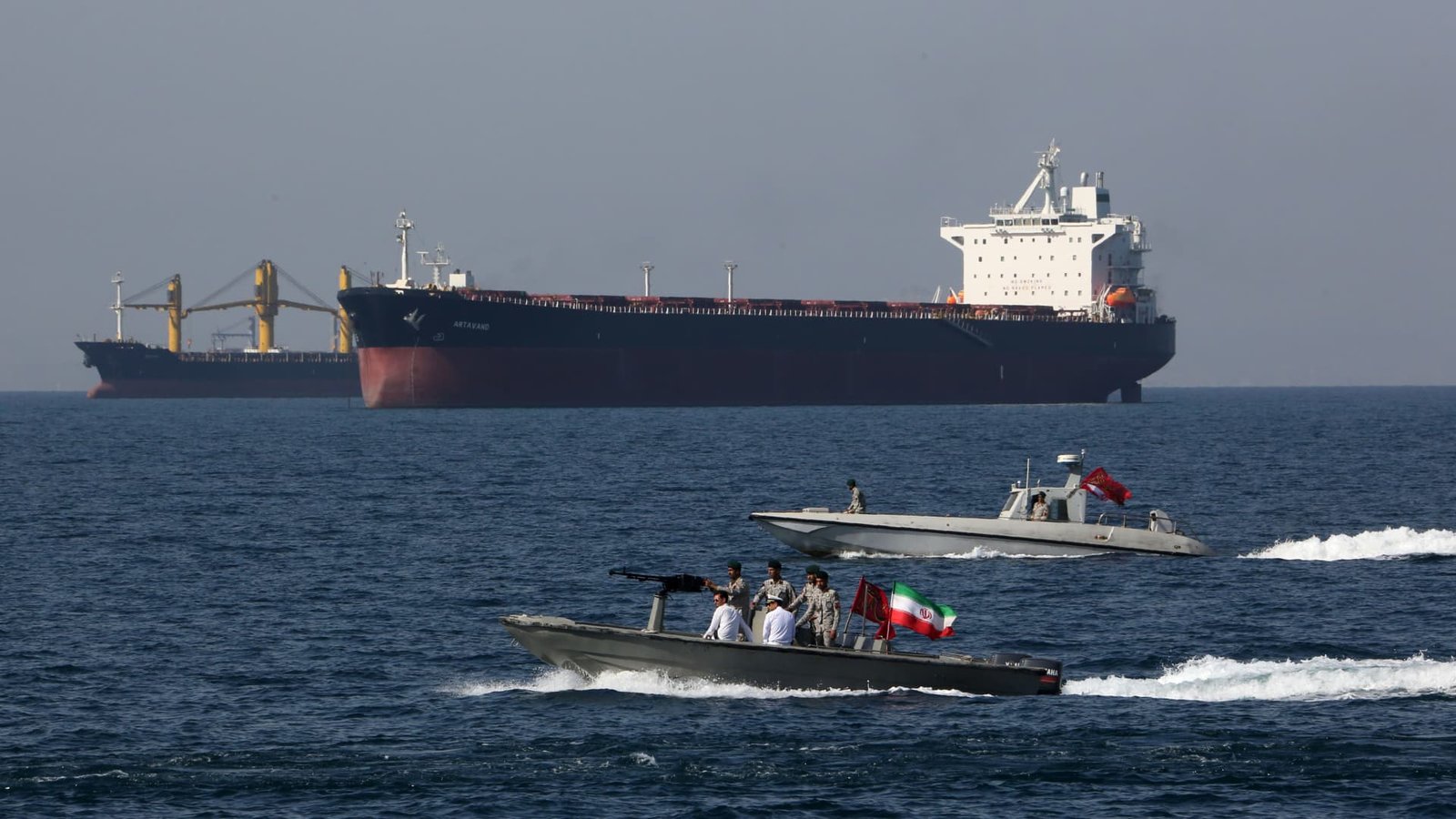
Tankers depicted in the Strait of Hormuz — a strategically important waterway which separates Iran, Oman and the United Arab Emirates.
ATTA KENARE | AFP | Getty Images
As tensions surge following Israeli strikes on Iran, fears have resurfaced that the Tehran could retaliate by targeting one of the world’s most vital oil arteries — the Strait of Hormuz.
The Strait of Hormuz, which connects the Persian Gulf to the Arabian Sea, sees roughly 20 million barrels per day of oil and oil products pass through, accounting for nearly one-fifth of global oil shipments. Any move to block it would ripple through energy markets.
However, market watchers believe a full-scale disruption of global oil flows by closing the waterway is unlikely, and might even be physically impossible.
There really is “no net benefit” that comes with impeding the passage of oil through the Strait of Hormuz, especially given how Iranian oil infrastructure has not been directly targeted, said Ellen Wald, co-founder of Washington Ivy Advisors. She added that any such action would likely trigger further retaliation.
She also warned that any major spike in oil prices caused by a closure could draw backlash from Iran’s largest oil customer: China.
Their friends will suffer more than their enemies… So it’s very hard to see that happening.
Anas Alhajji
Energy Outlook Advisors
“China does not want the flow of oil out of the Persian Gulf to be disrupted in any way, and China does not want the price of oil to rise. So they’re going to bring the full weight of their economic power to bear on Iran,” Wald explained.
China is the number one importer of Iranian oil, reportedly accounting for over three-quarters of its oil exports. The world’s second-largest economy is also Iran’s largest trade partner.
“Their friends will suffer more than their enemies … So it’s very hard to see that happening,” said Anas Alhajji, managing partner at Energy Outlook Advisors, adding that disrupting the channel could be more of a bane than a boon for Tehran, given how most of Iran’s daily consumption goods come via that route.
“It’s not in their interest to cause problems because they will suffer first.”
Iran in 2018 threatened to shut the Strait of Hormuz when tensions spiked following the U.S. withdrawal from the nuclear deal and the reimposition of sanctions. Prior to that, another major threat reportedly came in 2011 and 2012, when Iranian officials, including then–Vice President Mohammad-Reza Rahimi, warned of a potential closure if the West slapped further sanctions on its oil exports over its nuclear program.
Impossible to close the strait?
The Strait of Hormuz, which is 35 to 60 miles (55 to 95 kilometers) wide, connects the Persian Gulf and the Arabian Sea.
The idea of shutting the Hormuz waterway has been a recurring rhetorical tool but never been acted upon, with analysts saying that it’s simply not possible.
“Let’s be real about the Strait of Hormuz. First of all, most of it is in Oman, not in Iran. Number two, it’s wide enough that the Iranians cannot close it,” said Alhajji.
Similarly, Washington Ivy Advisors’ Wald noted that although many ships pass through Iranian waters, vessels can still traverse alternative routes via the United Arab Emirates and Oman.
“Any blockade of the Strait of Hormuz will be a ‘last resort’ option for Iran and likely contingent on a military engagement between U.S. and Iran,” said Vivek Dhar, Commonwealth Bank of Australia’s director of mining and energy commodities research.
RBC Capital Markets’ Helima Croft suggested that while there could be some disruption, a full-scale blockade was unlikely.
“It is our understanding that it would be extremely difficult for Iran to close the strait for an extended period given the presence of the US Fifth Fleet in Bahrain. Nevertheless, Iran could still launch attacks on tankers and mine the strait to disrupt maritime traffic,” said Croft, head of global commodity strategy and MENA research at RBC.
U.S. President Trump has warned of possible military action if negotiations with Iran over its nuclear program break down, but it is uncertain whether these threats are meant to raise the stakes of U.S.-Iran talks or simply to increase pressure at the negotiating table, said Dhar.
Israel carried out a wave of airstrikes on Iran early Friday morning local time, claiming the attacks were aimed at facilities linked to Tehran’s nuclear program.

According to Iranian state media, the strikes killed Mohammad Hossein Bagheri, chief of the Iranian Armed Forces, along with Hossein Salami, the commander-in-chief of Iran’s Islamic Revolutionary Guard Corps.
While a closure of the strait remains highly unlikely, the escalating conflict has prompted some to consider even the faint possibility.
“[Closing the strait] is kind of an extreme scenario, although we are in an extreme situation,” said Amena Bakr, head of Middle East and OPEC+ insights at Kpler.
“So that’s why I’m not putting that option completely off the table. We need to consider it.”
Crude futures jumped as much as 13% after Israel launched airstrikes against Iran early Friday. Global benchmark Brent futures were up 6.5% at $73.88 per barrel as of 4.30 p.m. Singapore time, while the U.S. West Texas Intermediate was trading 6.7% higher at $72.57 per barrel.
