Here’s our Club Mailbag email investingclubmailbag@cnbc.com — so you send your questions directly to Jim Cramer and his team of analysts. We can’t offer personal investing advice. We will only consider more general questions about the investment process or stocks in the portfolio or related industries. This week’s question: It seems that after DeepSeek, the Magnificent Seven, and faith in American exceptionalism, is down. China’s and Germany’s performances are up. Foreign investors have always bought up U.S. stocks — but are now getting out in droves and buying European stocks. Are the Magnificent Seven bad investments? Should a smart investor sell big tech and largely get into Europe and China stocks? — Gary Despite the recent underperformance in our stock market compared to Europe, U.S. stocks are not bad investments. Rather, investors may need to be more selective moving forward. U.S. stocks have come under pressure this year, particularly after President Donald Trump ‘s April 2 announcement of “reciprocal” tariffs disturbed markets. The bond market sold off as well, with yields rising and fears of higher inflation intensifying. Major tech names like Apple and Nvidia were hit hard due to their dependence on global supply chains and exposure to China, which was excluded from Trump’s April 9 pause on country-specific levies. Trade tensions eased between the U.S. and China on May 12, giving both sides time to consider next steps. This past Friday brought new trade twists, with Trump saying Apple , Samsung and other smartphone makers should be subject to a 25% tariff on devices not manufactured in the United States. Also Friday, the president suggested a 50% tariff on European Union imports into the U.S., beginning June 1. These threats masked any optimism from the U.S. and China continuing their trade talks. All that was before Moody’s late on Friday, May 16 downgraded by one notch its rating on U.S. government debt from its highest level. That brings Moody’s in line with the Standard & Poor’s downgrade of August 2011, and Fitch’s downgrade in August 2023. The S & P move was a surprise and crushed the market. The Fitch move hit the market, but not nearly as much. Wall Street last Monday shook off the Moody’s news, with stocks little changed on the session. The real action that Monday was the surge in bond yields, with the 10-year Treasury yield topping 4.6% before cooling off a bit. .GDAXI .SPX YTD mountain Dax vs. S & P 500 YTD “What’s happening that didn’t happen then is there is an alternative” to U.S. stocks, Jim Cramer said on “Squawk on the Street” last week. “The money keeps going to these European stocks, and it’s rather amazing.” Year to date, Germany’s Dax index gained 19% versus the S & P 500’s decline of more than 1%, as of Friday’s close. Barclays noted the “end of U.S. exceptionalism could well be Europe’s chance,” highlighting the European Central Bank’s greater flexibility to cut interest rates and more attractive stock valuations. “Other markets will have their brief moments, but I would never bet against the United States over the long term,” said Jeff Marks, the Club’s director of portfolio analysis. While short-term performance can favor different regions of the world, the S & P 500 has consistently delivered stronger long-term returns. Over the past 10 years, according to FactSet, the S & P 500 gained nearly 173% compared to the Dax’s double. With dividends reinvested, the S & P 500 return over the past decade was more than 225%. Investment firm KKR favors this view too. The firm published its Global Macro Trends for May, addressing key investor questions, including one regarding how some investors are considering selling down their U.S. assets. “Many CIOs [chief investment officers] are considering moving assets out of the United States towards other parts of the world. While the theory behind this shift is understandable, the practicality of the execution is difficult,” KKR wrote. The analysts explained that’s because of the unique merits of the U.S. stock market, one of which is its sheer size – nearly twice the size of Europe, Japan, and India, combined. KKR added before bowing out of U.S. stocks, investors should also know “many U.S. companies are large, liquid names that have low leverage and solid earnings growth” and “their returns on capital are often higher too.” .SPX .GDAXI mountain 2015-05-23 S & P 500 vs. Dax 10 years After traveling in Europe, Jim recounted in his May 11 Sunday column that European markets are “roaring.” He added, “They are crushing it with stock performance that is outstanding, in many cases backed up by earnings, and the enthusiasm for their economies is everywhere.” In contrast, he wrote, “The U.S. is falling at least in comparison with our European cousins. When you have that level of distance in performance, especially where we were a few weeks ago, America is hideously underperforming.” He also said that our European counterparts “just seem a lot safer and predictable” and estimated “they can continue to climb given the momentum.” Jim, like Jeff, still sees opportunity in U.S. stocks if the share prices are right. “There are tons of stocks I would like to buy if the prices come down.” During last Wednesday’s Monthly Meeting, Jim talked about six stocks to buy and five stocks he’s most worried about . Apple topped Jim’s worry list even before Friday’s Trump tariff saga. U.S. investors who may be in favor of international equities should recognize that owning S & P 500 companies provides substantial international exposure. That’s because many S & P 500 companies generate a large share of their revenues outside of the U.S. This means you are indirectly exposed to global growth and don’t have to look outside of U.S. stocks for international exposure. Ultimately, Jim is not a fan of the “sell America” trade and prefers a more constructive approach. He outlined a new playbook for the market on “Mad Money” on April 3 , when the market sold off on the “reciprocal” tariff announcement. He said that instead of blanket selling — “buy some different stocks and maybe trim some of the newfound riskier ones.” His approach to finding new opportunities in the Trump tariff regime is: “Stocks of domestic companies with pricing power, with no slackening of demand or credit risk, that do well in a slowdown.” This is what works and what we are buying for the Charitable Trust. (See here for a full list of the stocks in the Trust.) As a subscriber to the CNBC Investing Club with Jim Cramer, you will receive a trade alert before Jim makes a trade. Jim waits 45 minutes after sending a trade alert before buying or selling a stock in his charitable trust’s portfolio. If Jim has talked about a stock on CNBC TV, he waits 72 hours after issuing the trade alert before executing the trade. THE ABOVE INVESTING CLUB INFORMATION IS SUBJECT TO OUR TERMS AND CONDITIONS AND PRIVACY POLICY , TOGETHER WITH OUR DISCLAIMER . NO FIDUCIARY OBLIGATION OR DUTY EXISTS, OR IS CREATED, BY VIRTUE OF YOUR RECEIPT OF ANY INFORMATION PROVIDED IN CONNECTION WITH THE INVESTING CLUB. NO SPECIFIC OUTCOME OR PROFIT IS GUARANTEED.
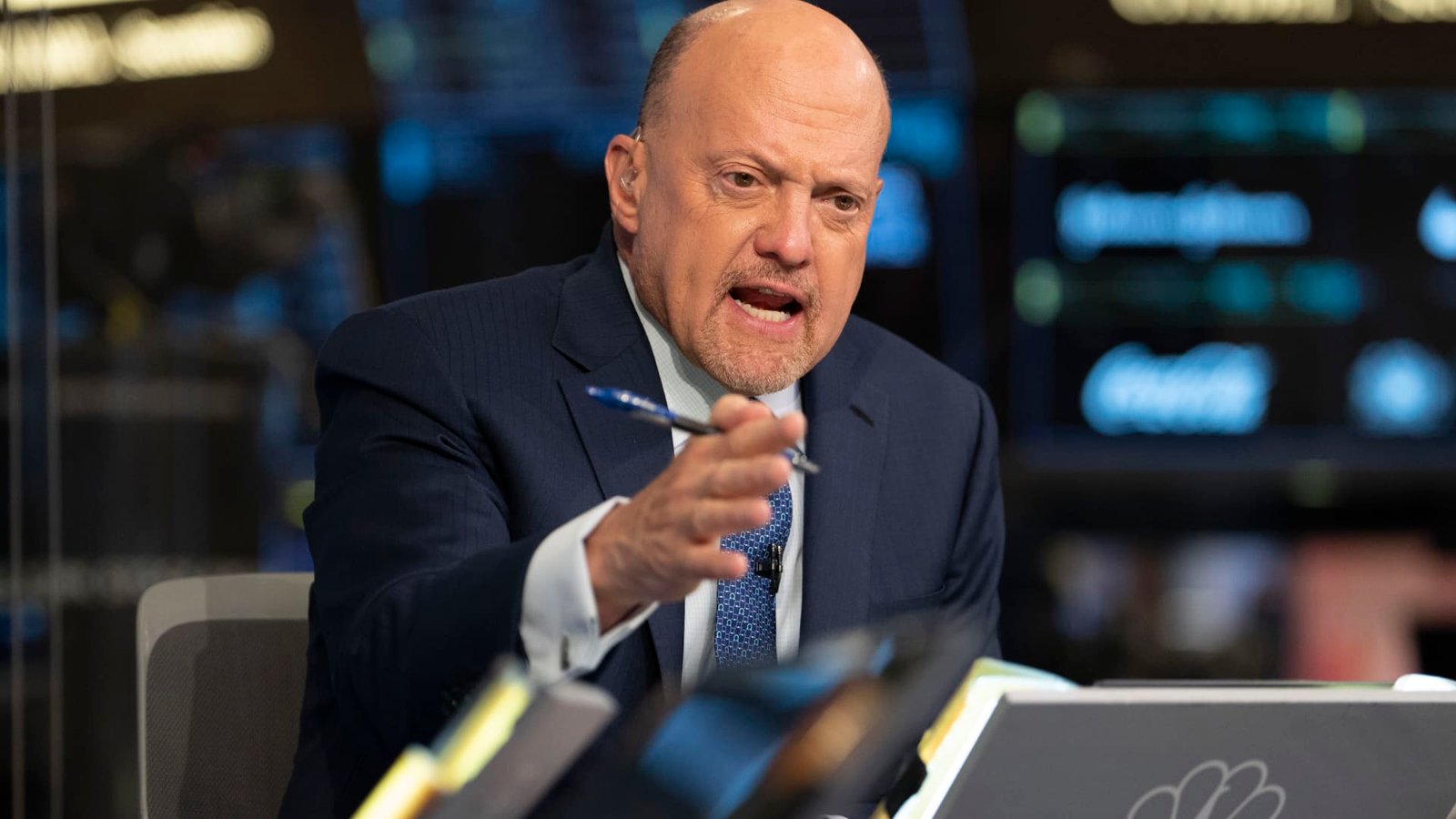
Jim Cramer on Squawk on the Street, June 30, 2022.
Virginia Sherwood | CNBC
Here’s our Club Mailbag email investingclubmailbag@cnbc.com — so you send your questions directly to Jim Cramer and his team of analysts. We can’t offer personal investing advice. We will only consider more general questions about the investment process or stocks in the portfolio or related industries.
This week’s question: It seems that after DeepSeek, the Magnificent Seven, and faith in American exceptionalism, is down. China’s and Germany’s performances are up. Foreign investors have always bought up U.S. stocks — but are now getting out in droves and buying European stocks. Are the Magnificent Seven bad investments? Should a smart investor sell big tech and largely get into Europe and China stocks? — Gary