

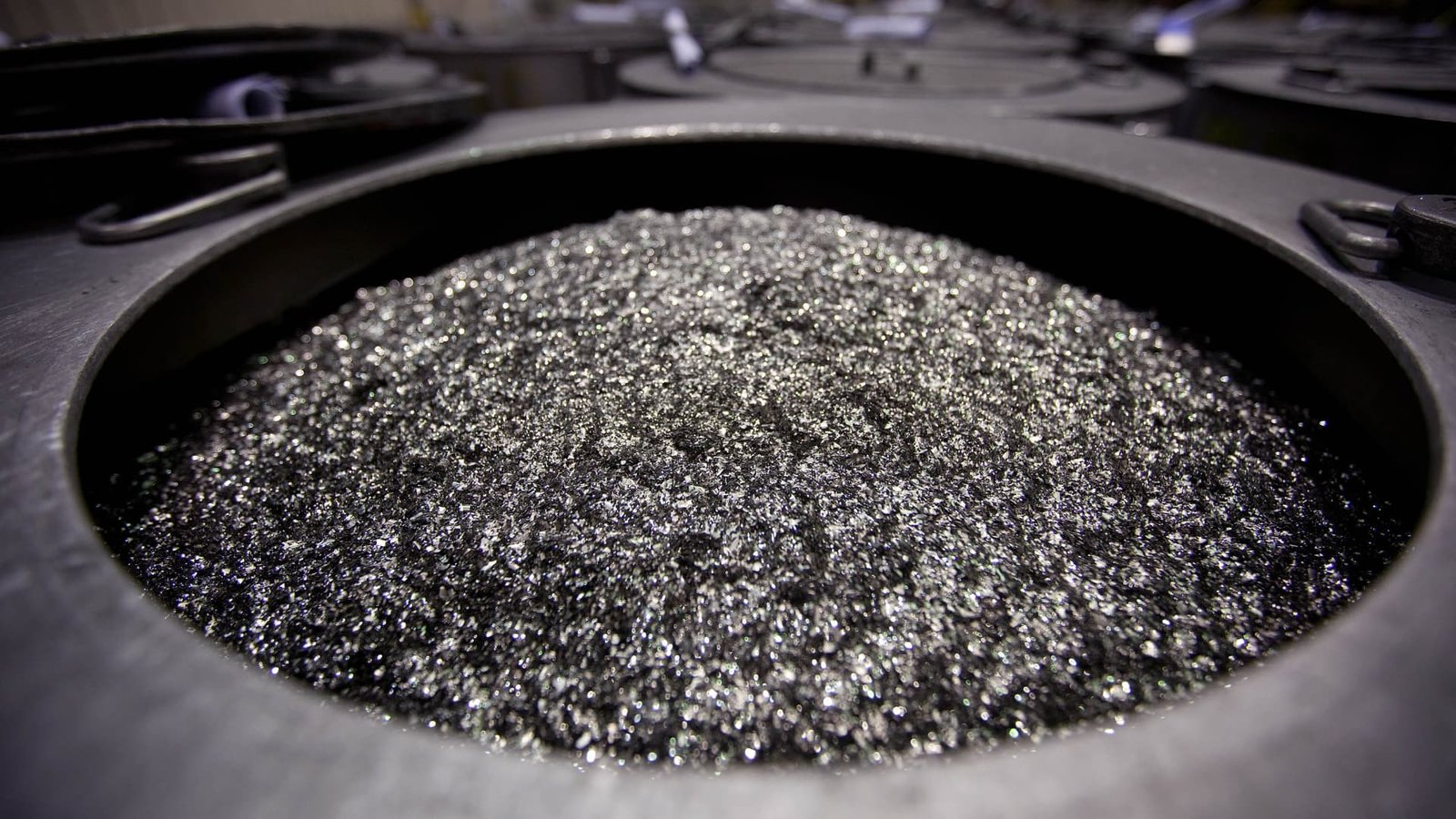
Annealed neodymium iron boron magnets sit in a barrel prior to being crushed into powder at Neo Material Technologies Inc.’s Magnequench Tianjin Co. factory in Tianjin, China.
Bloomberg | Bloomberg | Getty Images
BEIJING — As China tightens its grip on the global supply of key minerals, the West is working to reduce its dependence on Chinese rare earth.
This includes finding alternative sources of rare earth minerals, developing technologies to reduce reliance, and recovering existing stockpiles through recycling products that are reaching the end of their shelf life.
“You cannot build a modern car without rare earths,” said consulting firm AlixPartners, noting how Chinese companies have come to dominate the supply chain for the minerals.
In September 2024, the U.S. Department of Defense invested $4.2 million in Rare Earth Salts, a startup that aims to extract the oxides from domestic recycled products such as fluorescent light bulbs. Japan’s Toyota has also been investing in technologies to reduce the use of rare earth elements.
According to the U.S. Geological Survey, China controlled 69% of rare earth mine production in 2024, and nearly half of the world’s reserves.
Analysts from AlixPartners estimate that a typical single-motor battery electric vehicle includes around 550 grams (1.21 pounds) of components containing rare earths, unlike gasoline-powered cars, which only use 140 grams of rare earths, or about 5 ounces.
Pretty soon, the first generation of EVs will be up for recycling themselves, creating a pool of ex-China material that will be under the control of the West.
Christopher Ecclestone
Principal and mining strategist at Hallgarten & Company
More than half of the new passenger cars sold in China are battery-only and hybrid-powered cars, unlike the U.S., where they are still mostly gasoline-powered.
“With slowing EV uptake (in the U.S.) and mandates to convert from ICE to EV formats receding into the future, the imperative for replacing Chinese-sourced materials in EVs is declining,” said Christopher Ecclestone, principal and mining strategist at Hallgarten & Company.
“Pretty soon, the first generation of EVs will be up for recycling themselves, creating a pool of ex-China material that will be under the control of the West,” he said.

Only 7.5% of new U.S. vehicle sales in the first quarter were electric, a modest increase from a year ago, according to Cox Automotive. It pointed out that around two-thirds of EVs sold in the U.S. last year were assembled locally, but manufacturers still rely on imports for the parts.
“The current, full-blown trade war with China, the world’s leading supplier of EV battery materials, will distort the market even more.”
Rare torque
Of the 1.7 kilograms (3.74 pounds) of components containing rare earths found in a typical single-motor battery electric car, 550 grams (1.2 pounds) are rare earths. About the same amount, 510 grams, is used in hybrid-powered vehicles using lithium-ion batteries.
In early April, China announced export controls on seven rare earths. Those restrictions included terbium, 9 grams of which is typically used in a single-motor EV, AlixPartners data showed.
None of the six other targeted rare earths are significantly used in cars, according to the data. But April’s list is not the only one. A separate Chinese list of metal controls that took effect in December restricts exports of cerium, 50 grams of which AlixPartners said is used on average in a single-motor EV.
The controls mean that Chinese companies handling the minerals must get government approval to sell them overseas. Caixin, a Chinese business news outlet, reported on May 15, just days after a U.S.-China trade truce, that three leading Chinese rare earth magnet companies have received export licenses from the commerce ministry to ship to North America and Europe.
What’s concerning for international business is that there are barely any alternatives to China for obtaining the rare earths. Mines can take years to get operating approval, while processing plants also take time and expertise to establish.
“Today, China controls over 90% of the global refined supply for the four magnet rare earth elements (Nd, Pr, Dy, Tb), which are used to make permanent magnets for EV motors,” the International Energy Agency said in a statement. That refers to neodymium, praseodymium, dysprosium and terbium.

For the less commonly used nickel metal hydride batteries in hybrid cars, the amount of rare earths goes up to 4.45 kilograms, or nearly 10 pounds, according to AlixPartners. That’s largely because that kind of battery uses 3.5 kilograms of lanthanum.
“I estimate that around 70% of the over 200 kilograms of minerals in an EV goes through China, but it varies by vehicle and manufacturer. It’s hard to put a definitive figure on it,” said Henry Sanderson, associate fellow at The Royal United Services Institute for Defence and Security.
Power projection
However, there are limits to recycling, which remains challenging, energy-intensive and time-consuming. And even if adoption of EVs in the U.S. slows, the minerals are used in far larger quantities in defense.
For example, the F-35 fighter jet contains over 900 pounds of rare earths, according to the Center for Strategic and International Studies, based in Washington, D.C.
China’s rare earths restrictions also go beyond the closely watched list released on April 4.
Large rocks containing chromite, is crushed into smaller bitesize chunks, before to goes through a process to refine and extract the ore that yields chromium, a vital component of stainless steel, at the Mughulkhil mine in Logar Province, Afghanistan.
Marcus Yam | Los Angeles Times | Getty Images
In the last two years, China has increased its control over a broader category of metals known as critical minerals. In the summer of 2023, China said it would restrict exports of gallium and germanium, both used in chipmaking. About a year later, it announced restrictions on antimony, used to strengthen other metals and a significant component in bullets, nuclear weapons production and lead-acid batteries.
The State Council, the country’s top executive body, in October released an entire policy for strengthening controls of exports, including minerals, that might have dual-use properties, or be used for military and civilian purposes.

Subscribe now
One restriction that caught many in the industry by surprise was on tungsten, a U.S.-designated critical mineral but not a rare earth. The extremely hard metal is used in weapons, cutting tools, semiconductors and car batteries.
China produced about 80% of the global tungsten supply in 2024, and the U.S. imports 27% of tungsten from China, data from the U.S. Geological Survey showed.
About 2 kilograms of tungsten is typically used in each electric car battery, said Michael Dornhofer, founder of metals consulting firm Independent Supply Business Partner. He pointed out that this tungsten is not able to return to the recycling chain for at least seven years, and its low levels of use might not even make it reusable.
“50% of the world’s tungsten is consumed by China, so they have business as usual,” Lewis Black, CEO of tungsten mining company Almonty, said in an interview last month. “It’s the other 40% that’s produced (in China) that comes into the West that doesn’t exist.”
He said when the company’s forthcoming tungsten mine in South Korea reopens this year, it would mean there would be enough non-China supply of the metal to satisfy U.S., Europe and South Korean needs for defense.
But for autos, medical and aerospace, “we just don’t have enough.”
