

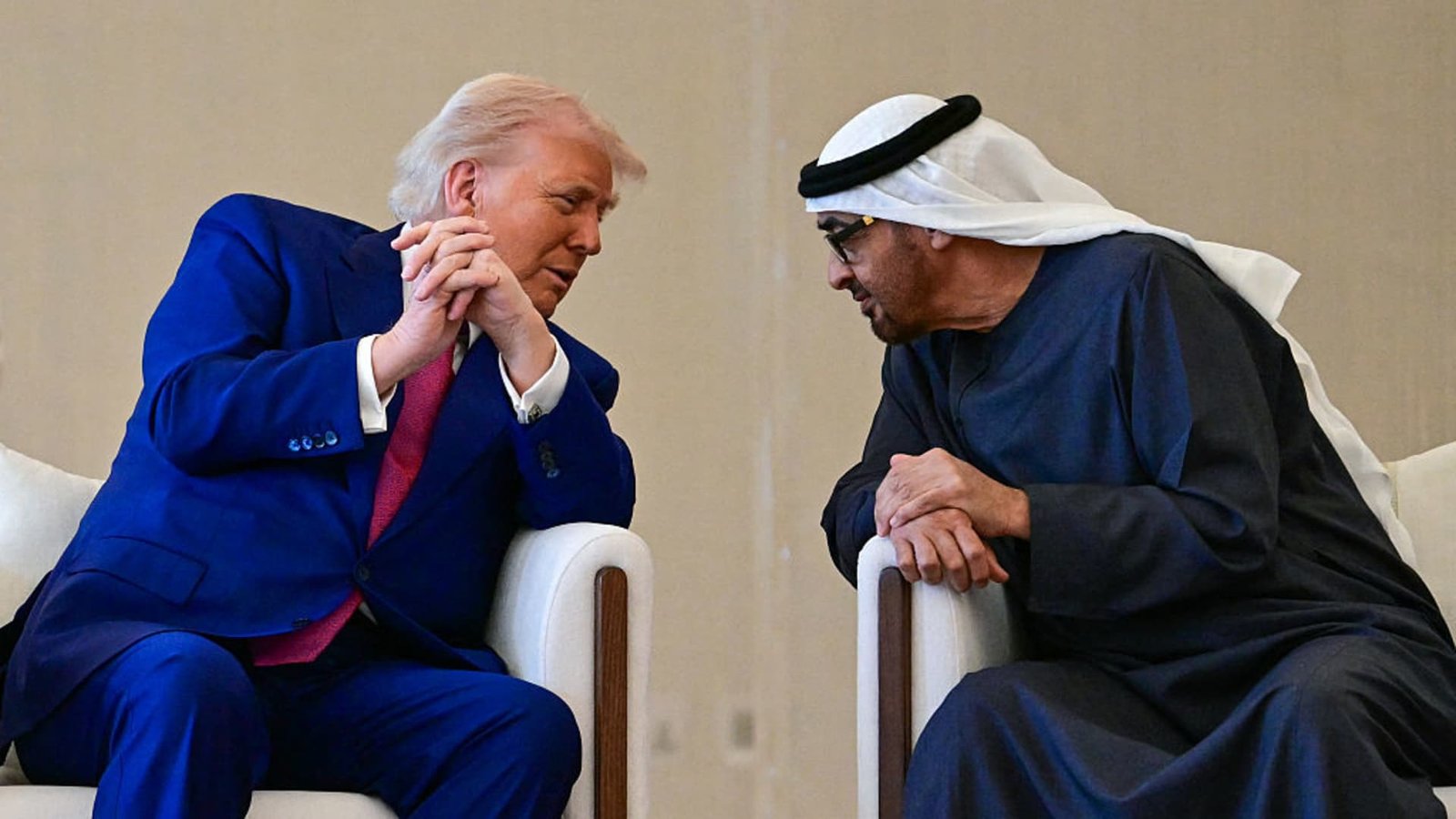
UAE President Sheikh Mohamed bin Zayed Al Nahyan (R) welcomes his US counterpart Donald Trump upon arrival at the presidential terminal in Abu Dhabi on May 15, 2025.
Giuseppe Cacace | Afp | Getty Images
DUBAI, United Arab Emirates — Deep in the oil-rich deserts of the Middle East, the United Arab Emirates is on a mission to establish supremacy in the field of artificial intelligence.
Seven thousand miles across the planet, the United States, led by President Donald Trump, wants American firms to dominate the global AI race.
While their goals may be separated by continents, their ambitions are strikingly aligned.
The U.S. currently makes the world’s most advanced semiconductor chips, while the UAE and neighboring Gulf countries have the abundant, cheap energy needed to power enormous AI data centers. The two countries have been allies for half a century, and Abu Dhabi embraced Trump during the U.S. president’s visit this month with unprecedented fanfare and investment pledges, many of which focused on tech and AI.
In the eyes of many investors, financial leaders, and political powers players from Silicon Valley and Washington to Abu Dhabi and Dubai, the two countries’ ever-strengthening AI alliance — to which hundreds of billions of dollars have already been committed — is a match made in heaven.
“Energy‑rich Gulf nations join the roster of trusted partners just as U.S. data‑center grids hit their physical limits,” Myron Xie, an analyst at SemiAnalysis, told CNBC.
At the same time, “the UAE gains access to advanced compute and talent, helping it pursue its own sovereign AI goals,” Xie said. “The Middle East, flush with cheap energy and capital, is poised to become the next regional AI hub.”

In the UAE, the developments are part of a long-term strategy by the Gulf sheikhdom to position itself as a global leader in AI. This, the country’s leadership holds, will enhance its geopolitical influence, diversify its economy beyond crude oil dependency, and assert itself as a technological powerhouse.
The goal for Washington is clear: to ensure American companies lead the global AI race with China and spread American tech around the world.
Trump’s Middle East visit in mid-May — which featured stops in Riyadh, Doha, and Abu Dhabi — saw the announcement of over $200 billion in commercial deals between the U.S. and the UAE. This brought the total of investment agreements in the Gulf region, including those from Saudi Arabia and Qatar, to over $2 trillion.
As part of the Abu Dhabi deals, OpenAI, Oracle, Nvidia and Cisco Systems announced that they will help build Stargate UAE AI campus launching in 2026. The Stargate Project is a $500 billion private sector AI-focused investment vehicle, announced by OpenAI in January in partnership with Abu Dhabi investment firm MGX and Japan’s SoftBank.
The companies said an initial 200-megawatt AI cluster should launch in Abu Dhabi next year. And the AI campus deal means the UAE gets access to many of Nvidia’s latest chips, American technology and software.
It’s the kind of agreement that would have faced restrictions under the previous U.S. administration, but Trump has looked to change the way is approaching tech export restrictions.
His administration plans to rescind a Biden era “AI diffusion rule,” which imposed strict export controls on advanced AI chips even to U.S.-friendly nations. that doing away with these limits could open the door for the sensitive American technology to end up in the hands of rivals like China — a topic of ongoing debate among U.S. lawmakers and security professionals.
‘Compute, not crude’
Once known primarily as a partnership centered around oil exports and weapons purchases, the pillars of the U.S.-Gulf relationship are changing, says Mohammed Soliman, senior fellow at the Middle East Institute in Washington DC.
“Compute, not crude, is going to be the central pillar of the U.S.-Gulf relationship,” Soliman said. “Moving forward, it’s no longer going to be only about energy policy; it is going to be about compute and how we and the Gulf are building an AI ecosystem that’s able to service third markets, emerging markets.”
Compute, in the context of AI, refers to the computational resources, like hardware and processing power, needed to train and run AI models.
“And this is a huge inflection point for the relationship [compared to] where we were a few years ago,” Soliman said, speaking on a Middle East Institute podcast recorded on May 19. “Moving forward, the relationship is going to be much more impactful on technical questions around AI, data centers, and chips than ever before.”

Notably, the UAE has bet fully on a U.S.-led AI future — a particularly salient point within the context of U.S.-China competition.
Emirati AI company G42, which has major partnerships with OpenAI, Nvidia and Microsoft, to name a few, has fully divested from Chinese companies — including an estimated $100 million stake in TikTok owner ByteDance — to avert U.S. Commerce Department sanctions and retain access to Nvidia chips and other U.S. technology that powers AI applications.
“So far right now, we are racing to have the best large language model and ultimately to have AGI (artificial general intelligence),” said Baghdad Gherras, a UAE-based venture partner at Antler, which invests in early-stage AI ventures.
AGI generally refers to artificial intelligence that is smarter than humans, though definitions vary.
“For the UAE, if they want to be a leader in the AI race, the first thing that they have to secure is compute. If you don’t have compute, you won’t have a seat in terms of AI leadership,” Gherras told CNBC.
He added that the UAE “decided to re-shift the geo-economic focus from China to the U.S., because they understood that Nvidia makes by far the best chips for AI, but also the entire semiconductor supply chain is mostly in Taiwan.”
Still, Gherras noted, China “is catching up really fast, crazy fast.”
‘Tremendous level of influence’
The UAE’s development of its own large language model (LLM), Falcon AI, represents a major step for the region in AI development — but it also provides the foundation for the country’s geopolitical and economic ambitions to dominate the AI market within the next decade.
Such a position would also enhance the Emirates’ diplomatic leverage, allowing it to play a more influential role in global tech governance and policy discussions.

“If those ambitions become reality, you might see the Gulf acting as a region that offers compute as a service for the rest of emerging markets,” the Middle East Institute’s Soliman said.
“Think about the Gulf as a place that houses large language models in Swahili, in Hindi, in these languages, and they are able to offer housing data, training data, inference for all these economies, because they have the infrastructure,” he added. “So they become their AI leader for the emerging markets.”
“And this is a tremendous, tremendous level of influence, tremendous level of development,” Soliman emphasized. “Where they used to serve as energy producers, to become a back-end for AI applications — this is really, really massive.”
U.S. pushes American AI
Part of the U.S.’s push in the UAE and the broader region comes down to a desire for American technology to establish supremacy globally and push back the advances of China.
On the one hand, U.S. export curbs have restricted access for companies like Nvidia to sell advanced technology to China. It has also stopped China access some technology to advance its own development in areas like semiconductors and AI.
At the same time, Washington is opening up new markets, like the Middle East, to its biggest tech companies.
“The move has a political angle, as it bolsters the U.S. compute supply chains while constraining China. It grants the U.S. an edge in the AI arms race, positioning the country for continued leadership,” David Meier, economist at Julius Baer, said in note earlier this month.

Beijing and Chinese companies have been trying to access new markets to push their technology across the globe, especially in areas like AI. But the U.S. has been working to entrench itself first and strike partnerships with governments to do so.
“The race is on to diffuse U.S.-based AI into every part of the world,” Daniel Newman, CEO of Futurum Group, told CNBC on Tuesday.
American companies have taken up the call. OpenAI, which struck a deal with the UAE last week to build AI infrastructure and roll out ChatGPT nationwide, has positioned itself as a countermeasure to China and as the business able to deliver U.S. artificial intelligence to countries around the world.
In February, OpenAI’s chief global affairs officer Chris Lehane told CNBC that the company sees a world in which there are two major AI models — one led by China’s Communist Party and a U.S.-led “small ‘d’ democratic” AI.
“If you’re a country and you’re looking to build your own AI ecosystem, your own AI hub, you’re building developers in your country which are going to be some version of the companies of the future, I think you would prefer to be seeing that built on a democratic AI system because it is going to facilitate your country being able to use this technology for your own nation building purposes,” Lehane said.
— CNBC’s Dylan Butts contributed to this report.
