

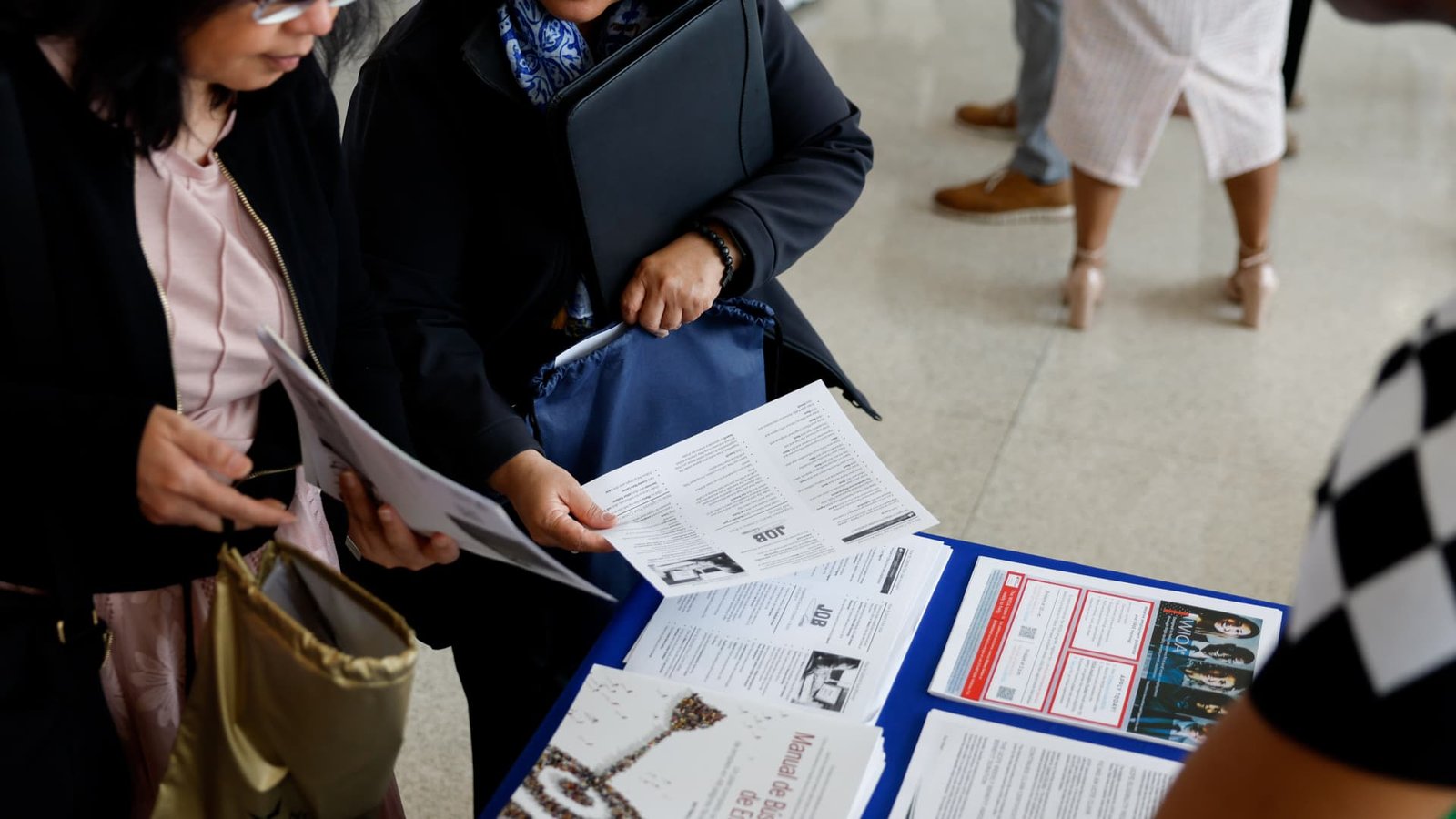
Job seekers at a job fair hosted by the Metropolitan Washington Airports Authority to support federal workers looking for new career opportunities, at Ronald Reagan Washington National Airport in Arlington, Virginia, on April 25, 2025.
Ting Shen/Bloomberg via Getty Images
While the unemployment rate in the U.S. is still fairly low, data shows it’s not uncommon to see individuals job hunting for extended periods of time.
The unemployment rate remained flat at 4.2% in May, the Bureau of Labor Statistics reported Friday.
However, over the past six months, it’s become “drastically harder to find a job,” whether you’re entering the job market for the first time or you’ve been looking for a while, according to Alí Bustamante, an economist and director at the Roosevelt Institute, a liberal think tank.
“It’s not that folks are losing their jobs,” Bustamante said. “It’s just that businesses are much more reticent to hire people, to make investments, because they just feel this very uncertain economic climate.”
More from Personal Finance:
Millions of Americans would lose health insurance under House GOP megabill
Check your home insurance ahead of an ‘above normal’ hurricane season
401(k) balances drop due to market volatility: Fidelity
Bustamante and other economists say several data points beyond the headline job market numbers — the job-finding and quits rates, the share of workers who have been unemployed for 27 weeks or more, a broader rate of unemployment and the state of so-called “white collar” jobs — showcase deeper issues within the labor market.
“Employers aren’t hiring, they’re not firing. People aren’t leaving their jobs, and there’s just fewer opportunities right now,” said Cory Stahle, an economist at Indeed, a job search site.
As career coach Mandi Woodruff-Santos put it during a recent interview with CNBC: “The job market is kind of trash right now.”
Here’s what’s happening with unemployed Americans, in five charts.
Job-finding, quits and hires are down
The job-finding rate reflects the share of unemployed workers who successfully found a job, Stahle said. Over the past few years, the job-finding rate for unemployment has been declining, he said.
In other words, people who are looking for work are not finding jobs, Stahle said.
On the flip side, the quits rate reflects the share of employees who have left their jobs in a given month, Stahle said. That figure has also been declining, meaning people are not voluntarily leaving their jobs.
The quits rate was at 2.0% in April, little changed from 2.1% in March, both numbers seasonally adjusted, according to the latest Job Openings and Labor Turnover report by the Bureau of Labor Statistics. The number of quits was down by 220,000 over the year.
Hiring activity has also been down in recent years. The rate of hires was at 3.5% in April, little changed from 3.4% in March, both seasonally adjusted, per the JOLTs report.
As people stay put in their jobs and employers are reluctant to hire, such factors create a “low hiring, low firing” environment, Stahle said.
Many workers are job hunting for at least 27 weeks
The number of long-term unemployed workers dropped in the bureau’s latest report. However, not only is the rate still high, the recent drop could also be a red flag, Bustamente said.
The share of unemployed workers facing long-term unemployment — those who have been jobless for at least 27 weeks — was a seasonally adjusted 20.4% in May, according to the bureau’s latest data. That’s down from a seasonally adjusted 23.5% in April.
But the recent decline may not be an improvement. It could be signaling that a large number of long-term unemployed workers left the labor force altogether, he said.
Considering that 139,000 jobs were added in May and about 218,000 workers are no longer in the unemployment cohort, there’s a significant gap of workers who were unemployed but did not secure new roles, Bustamante said.
What’s more, the number of people not in the labor force jumped by 622,000 in May.
“All the data point to long-term unemployment declining because people left the labor force,” Bustamante said.

A broader unemployment rate is high
While the headline unemployment rate — also known as the U-3 rate — has remained steady, another measure shows a clearer picture of what’s happening with unemployed workers still looking for jobs, experts say.
The U-6 rate includes the total number of unemployed workers, plus all marginally attached workers, and the total employed part time for economic reasons.
Marginally attached workers are those who are neither working nor looking for a job — but indicate that they want and are available for work, and looked for a new role recently. There’s a subset of this group called discouraged workers, or those who are not currently looking for a job due to labor-market reasons.
People employed part time for economic reasons are those who want and are available for full-time work but settled for a part-time schedule.
As of the latest BLS data, the U-6 rate remained unchanged from April at 7.8%.
This data tells us that more and more Americans have either stopped looking for work out of labor-market frustrations, or are picking up part-time gigs to get by financially, experts say.
‘White collar’ industries contract; other sectors grow
When looking at professional and business services — the industry that represents “white collar,” and middle and upper-class, educated workers — there hasn’t been much hiring, experts say.
Fields such as marketing, software development, data analytics and data science have far fewer opportunities now than they did before the pandemic, Stahle said.
On the other hand, industries such as health care, construction and manufacturing have seen consistent job growth. Nearly half of the job growth came from health care, which added 62,000 jobs in May, the bureau found.
“There’s been a divergence in opportunity,” Stahle said. “Your experience with the labor market is going to depend largely on the type of work it is you’re doing.”
