

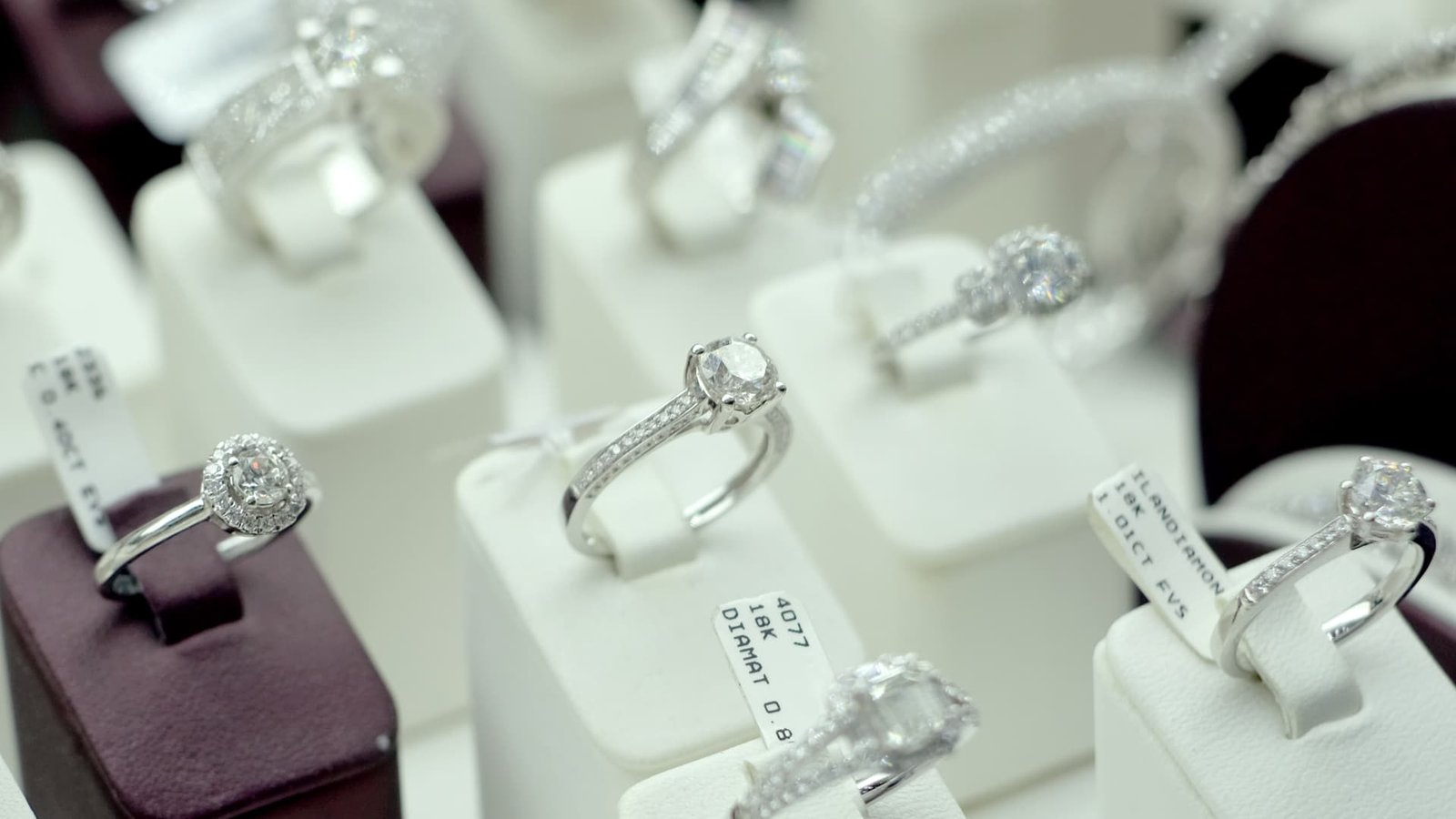
Diamond rings and bracelets on display in a show window in Antwerp, Belgium. (Photo by Yuriko Nakao/Getty Images)
Yuriko Nakao | Getty Images News | Getty Images
They might be made of the hardest material on earth, but diamonds, with their complex supply chains and expensive price tag, are particularly fragile to U.S. President Donald Trump’s aggressive tariff agenda.
The precious mineral is facing a baseline 10% import duty to the U.S. — a market accounting for over half of the global demand for polished diamonds. The sector is also bracing for additional duties should Trump’s 90-day pause come to an end with no new agreements.
“It’s very clear that the diamond industry, on a global level, has been facing a perfect storm of challenges,” Karen Rentmeesters, chief executive of the Antwerp World Diamond Centre told CNBC, adding that tariffs are just “the latest blow.”
The small precious stones often cross several borders before ending in a store. From mines in Botswana or South Africa, to trading hubs in the Middle East or Europe, and then on to cutting and polishing hubs, before heading back to a jewelry manufacturer — there is often a long journey before the item arrives in a store. This complex supply chain means the diamond industry is highly susceptible to any trade disruptions.
Raw materials such as gold and copper have been excluded from U.S. tariffs and the industry is pushing for diamonds to also be excluded.
Rentmeesters who heads the 580-year-old corporation which represents over 1,400 companies within Antwerp’s diamond district, said: “You could argue that loose diamonds are a raw material. You don’t walk around with a polished diamond in your hand. You’re wearing it in a piece of jewelry. It’s in a ring or a pair of earrings.”
The tariff uncertainty comes at a time when the luxury industry at large is already contending with a slowdown in demand after a post-pandemic boom and an economic slump in China.
Lab-grown diamonds mark an ongoing shift
However, the biggest disruption to the industry has been the creation of lab-grown diamonds (LGD). Chemically identical, the stones are impossible to distinguish with the naked eye. They are selling at an 80% discount to the natural version and customers are taking advantage of the cheaper prices.
Over half of couples surveyed in the U.S. last year, said their engagement ring featured a lab-grown diamond, according to the 2025 Real Weddings study by The Knot which included insights from nearly 17,000 couples.

A watershed moment was in 2021 when Pandora, the world’s largest jewelry brand by volume, became the first to stop selling mined diamonds.
“In the US, some 18 months ago, the volume of lab-grown diamonds in loose stones surpassed that of mined. So if there’s any doubt in people’s minds that there’s a shift going on, it was very visible from there, and since then, it keeps on growing,” Pandora CEO Alexander Lacik told CNBC.
“With this type of value proposition that lab grown diamonds can offer, we can actually offer diamonds to more people. So it’s not necessarily that we see that the total volume of diamonds is going to go down. We’ll probably invite more people into the category.”
With the poor macroeconomic conditions and increasing competition from LGD, the price of mined diamonds has fallen nearly 60% since a peak in March 2022.
Tariffs threaten stabilization point
However, some analysts say the industry is close to reaching a point of stabilization between LGD and mined diamonds. “The question you have to ask is, how much lower can prices go before consumers see clear differentiation between the two products,” said Paul Zimnisky, an independent diamond analyst.
He added: “And I think we’re finally starting to get to that point where you could buy, you know, a three, four or five carat, which are ridiculous sizes for an engagement ring — you could buy the lab grown version for, you know, just a few $1,000 whereas the natural version is going to be tens of hundreds of thousands of dollars. So, I think that price differential is certainly creating distinction.”
In the face of these challenges, some key players are rethinking their strategies.
De Beers, a major player in the diamond industry, said there were signs of an uptake in U.S. demand before Christmas and before the tariff uncertainty hit. Instead of investing in the burgeoning market of LGD, DeBeers is doubling down on natural diamonds.
De Beers recently announced it will close its LGD jewelry brand Lightbox in a bid to reinforce “its commitment to natural diamonds in the jewelry sector.”
“The persistently declining value of lab-grown diamonds in jewelry underscores the growing differentiation between these factory-made products and natural diamonds,” De Beers CEO Al Cook said in a company statement.
This photograph taken on February 6, 2024 shows employees working at Greenlab Diamonds, a firm manufacturing lab-grown gems on the outskirts of Surat.
Sam Panthaky | Afp | Getty Images
The firm said the closure is aligned with the strategy it presented in May last year, “to focus on high-return activities and streamline the business.”
The closure also comes at a time when Anglo American, De Beers’ parent company, is divesting the company and is in the process of looking for potential buyers.
In the current luxury slowdown jewelry has been a notable bright spot, especially the high-jewelry segment, seen as less cyclical catering to the most affluent clientele.
Earlier this month, Richemont beat expectations with revenues boosted by double-digit growth at the group’s Jewellery Maisons division, which includes Cartier, Van Cleef & Arpels and Buccellati.
According to analysts, the key for the mined industry going forward is in the messaging: “You have to remember a diamond, it’s a very emotional purchase. It’s not a practical purchase. And people like the story behind the creation,” Zimnisky said.
“I just think it’s up to the industry to provide consumers with the confidence they need if they’re going to spend significantly more for a natural diamond, they want to make sure it’s definitely a natural diamond. I think that should be the industry’s priority at this point.”
