

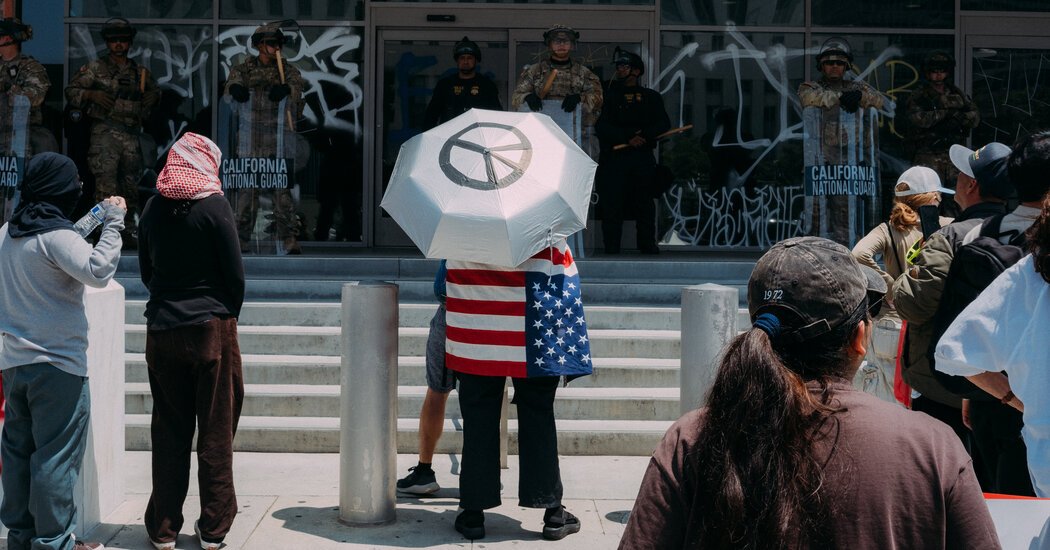
President Trump thinks he’s sending a message. By deploying waves of National Guard officers and active duty Marines to Los Angeles, he’s trying to show that he’s powerful and in control, that anyone who protests his policies will pay a price. This is a classic deterrence strategy: hit hard in one place to scare Americans into staying home.
But this strategy often backfires. If the majority of protests in Los Angeles reject violence, Mr. Trump may end up proving the opposite of what he intended: that he’s afraid, that the protesters are disciplined and that the threat isn’t the people — it’s him.
Counterinsurgency experts have long understood this dynamic. If you want to radicalize a population, there is no faster way than to use disproportionate force against civilians. David Kilcullen, a former senior adviser to General David Petraeus in Iraq, made this clear: Heavy-handed state violence doesn’t pacify dissent, it inflames it.
Another federal authority, the F.B.I., learned this lesson the hard way. In 1992 at Ruby Ridge in Idaho, an F.B.I. sniper shot and killed the wife of Randy Weaver while she stood in the doorway of her home, holding her baby. The F.B.I. had been called in to back up U.S. marshals who were engaged in a standoff with Mr. Weaver, whom they were trying to arrest on a fugitive warrant.
A year later in Waco, Texas, federal agents engaged in a 51-day standoff with the Branch Davidians, a religious sect whose leader, David Koresh, was being investigated for alleged child abuse and the unlawful stockpiling of weapons. The siege ended in disaster: The compound went up in flames and more than 75 people, including at least 20 children, died. Public trust in federal law enforcement plummeted. Militias exploded in size and number. Timothy McVeigh later cited Waco as one of the reasons he bombed the Oklahoma City federal building in 1995.
Since then, the F.B.I. has trod carefully when confronting American civilians, especially armed ones. In 2014, after the Nevada rancher Cliven Bundy had long refused to pay federal grazing fees and hundreds of armed supporters faced off with federal agents, law enforcement backed down rather than risk another Waco. And two years after that, during the 2016 occupation of the Malheur National Wildlife Refuge in Oregon (this time led by Mr. Bundy’s sons Ammon and Ryan Bundy), the bureau showed patience. For weeks agents avoided direct confrontation, choosing instead to wait, negotiate and de-escalate. It turns out that this strategy is more effective in avoiding violence.
These choices weren’t about weakness. They were about being smart. The F.B.I. knew that a disproportionate response erodes public trust and can spark anti-government violence. But that institutional memory now appears to be gone.
Mr. Trump is back in the White House and at the center of the decisions made by all the agencies under his control. The loyalist Pete Hegseth now directs the deployment of federal forces to Los Angeles. Along with other members of the president’s cabinet, such as Kristi Noem and Kash Patel, who have been deployed to support these efforts, the message is clear: Moderation and constitutional restraint is out; loyalty, aggression and public displays of strength are in.
What they may not appreciate is that unleashing the National Guard and the military against American protesters risks blowback. Not because the public will fight back with equal force. But because millions of Americans might finally, fully stop seeing the government as legitimate.
Nothing radicalizes a population faster than the sight of state agents brutalizing unarmed citizens.
Mahatma Gandhi understood this. So did Nelson Mandela and Martin Luther King Jr. Their movements succeeded not just because they were morally just, but also because they wielded nonviolence as a strategic weapon. When peaceful protesters are attacked by their own governments, the world takes notice. The moral high ground shifts. And people begin to see their leaders for who they really are.
Dr. King’s marches in Birmingham and Selma weren’t meant to avoid confrontation. They were designed to force the state to show its hand. Dr. King understood that the average American could not continue to deny injustice if he saw young people hit with fire hoses and beaten on national television. It would expose the lies the government had been telling him and reveal who was the truly evil side.
Mr. Trump and his inner circle do not appear to understand this calculus. Under the guise of insisting that federal officers are in danger, and that local authorities are inadequate to the task, the federal government has chosen to escalate at every turn. They may believe that brute force conveys strength. But history shows it does the opposite: It reveals fear. It reveals weakness. And it fuels resistance.
If Mr. Trump orders a crackdown on protesters, especially if those protesters are peaceful, multiracial and intergenerational, it could be his greatest political mistake yet. The optics would be devastating. Even people who have tuned out politics might wake up. Even those who supported Mr. Trump might flinch.
This is not to say that civil resistance is easy. Or that it always wins. But it gets stronger when it’s met with violence. That’s the thing autocrats forget. Crackdowns can shut people up for a while, but they also wake people up, and that’s when power starts to shift.
If Mr. Trump’s enforcers want to preserve what’s left of the country they claim to love, they would do well to remember Ruby Ridge. And Waco. And the long, painful lessons of American counterinsurgency.
