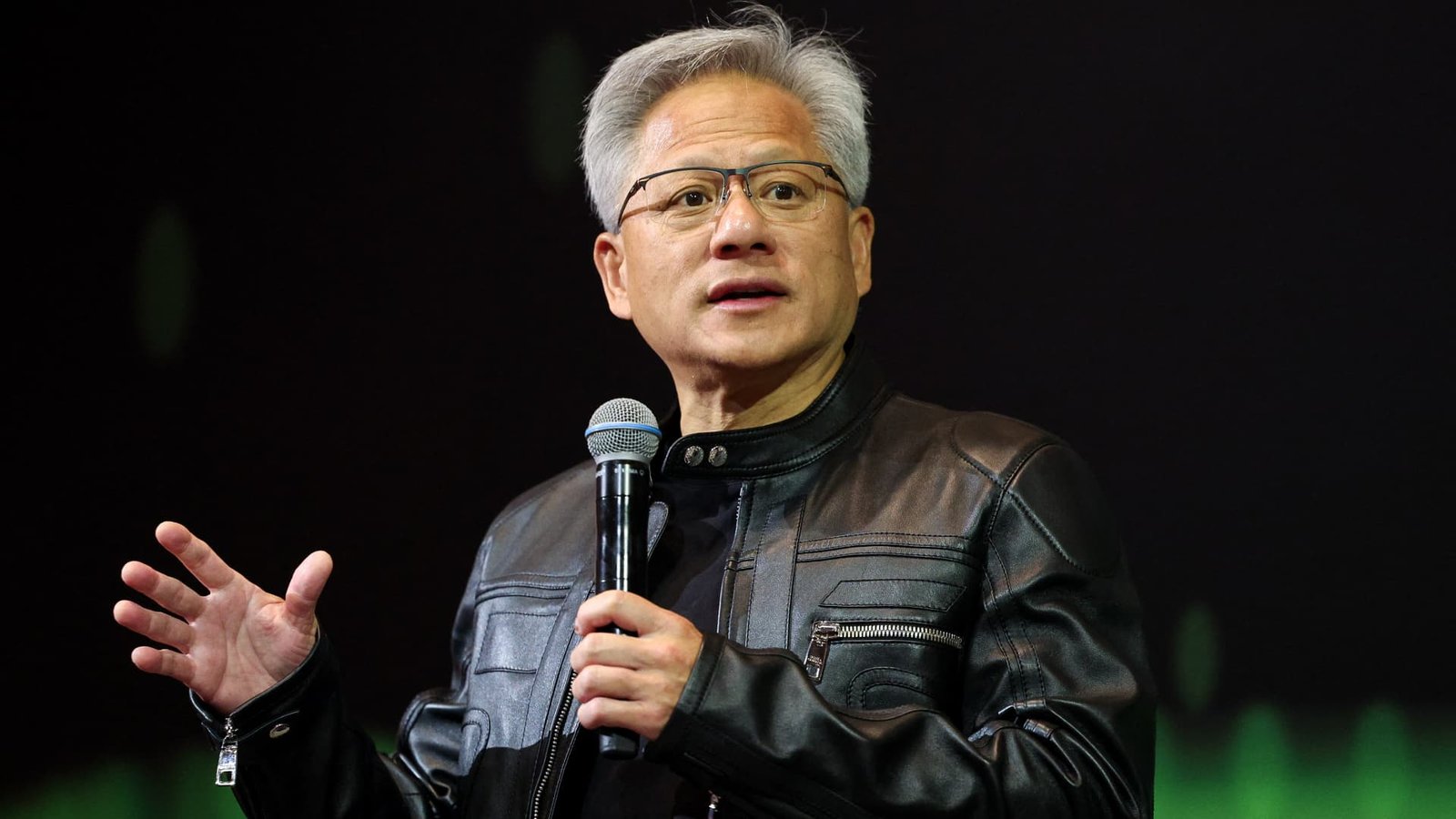
Jensen Huang, co-founder and CEO of Nvidia Corp., speaks during a news conference in Taipei on May 21, 2025.
I-hwa Cheng | Afp | Getty Images
Replacing Nvidia is a tall order. While Chinese competitors are years behind the company’s cutting-edge technology, many analysts and insiders warn they are catching up, thanks to U.S. export restrictions.
U.S. chip restrictions on the sale of advanced semiconductor technology, especially those used in artificial intelligence, have been rolled out over several years, with the initial aim of curbing China’s military advancement and protecting US dominance in the AI industry.
However, according to Nvidia CEO Jensen Huang, U.S. semiconductor export controls on China have been “a failure,” causing more harm to American businesses than to China.
While the goals of cutting back the Chinese military’s access to advanced U.S. technology and maintaining U.S. leadership in AI appear to have had some success on paper, loopholes and existing semiconductor stockpiles in China have complicated these aims, said Ray Wang, an independent tech and chip analyst with a focus on U.S.-China competition.
“That’s partly why we are seeing a closing of the gap between Chinese and U.S. AI capabilities,” added Wang.
A self-inflicted wound?
Leaders of Nvidia and other American chip designers have long lobbied against chip controls as they worry about losing lucrative business deals. Huang said at the annual Computex technology trade show in Taipei that Nvidia’s GPU market share in China fell to 50% from 95% over the past four years.
Indeed, chip experts say that the curbs create more harm than good for the U.S.
“The effects of the controls are twofold. They have the impact of reducing the ability of U.S. companies to access the China market and, in turn, have accelerated the efforts of the domestic industry to pursue greater innovation,” said Paul Triolo, Partner and Senior VP for China at DGA Group.
“You create competitors to your leading companies at the same time you’re cutting them off from a massive market in China,” he added.
While Washington’s most comprehensive export controls were passed during former U.S. President Joe Biden’s term in the White House, curbs on Huawei and SMIC, China’s largest chipmaker, go back to Donald Trump’s first term in office.
On April 15, Nvidia disclosed that new controls, which restricted sales of its H20 graphics processing units to China, had led to a $5.5 billion charge against its revenue.
Counter-intuitive curbs
The restrictions are expected to be a boon for the demand and development of local Nvidia alternatives like Huawei, which is working on its own AI chips. They also come against the background of Beijing mobilizing billions as part of its chip self-sufficiency campaign.
“The bottom line is, the controls have incentivized China to become self-sufficient across these supply chains in a way they never would have contemplated before,” Triolo said.
Chinese AI-related achievements, such as DeepSeek’s R1 model and news of Huawei chip progress, have led observers to question the effectiveness of chip controls.
According Wang, the independent analyst, China’s semiconductor and AI space has seen an acceleration of startups, market opportunities, and AI talent alongside the restrictions, which has clearly resulted in domestic innovations.
“I think the arguments that export controls accelerate innovation is quite valid,” Wang said.
Nivida’s Haung also noted these trends in April, telling lawmakers in Washington that the country has made enormous progress in the last several years and is right behind the U.S.
Moving goal posts?
Nvidia’s H20 chip was designed specifically to comply with existing chip controls prior to the clampdown on exports.
“We are not just talking about one export control, we are talking about a series of export controls that originate from all the way back in 2019,” said Wang, noting that the evolving policies have had a couple of different objectives.
Meanwhile, in what DGA’s Paul Trilio calls a “moving of the goalposts,” it seems that the aims of the restrictions have shifted to an intention to slow down and contain Chinese AI and semiconductor developments.
“The continued expansion of the controls, and the lack of an articulation of what the clear end game here is, has really created a lot of issues, and created a lot of collateral damage,” Trilio said, adding that it has led more people to question the policy.
In a statement earlier this month, the Information Technology & Innovation Foundation, a U.S. think tank which has received funding from various technology companies, said in a post that “the Biden administration’s export control policy for AI chips has largely been a failure since day one. Yet, year after year, it has doubled down, attempting to plug various loopholes.”
“While [the U.S. government] is certainly right to prevent U.S. companies from selling advanced AI technology to the Chinese military, cutting U.S. companies off from the entire commercial Chinese market is a cure worse than the disease,” Stephen Ezell of ITIF told CNBC in an email.
“U.S. export controls have cost NVIDIA at least $15 billion in sales, and those are revenues the company needs to be able to earn to invest in future generations of innovation.”