

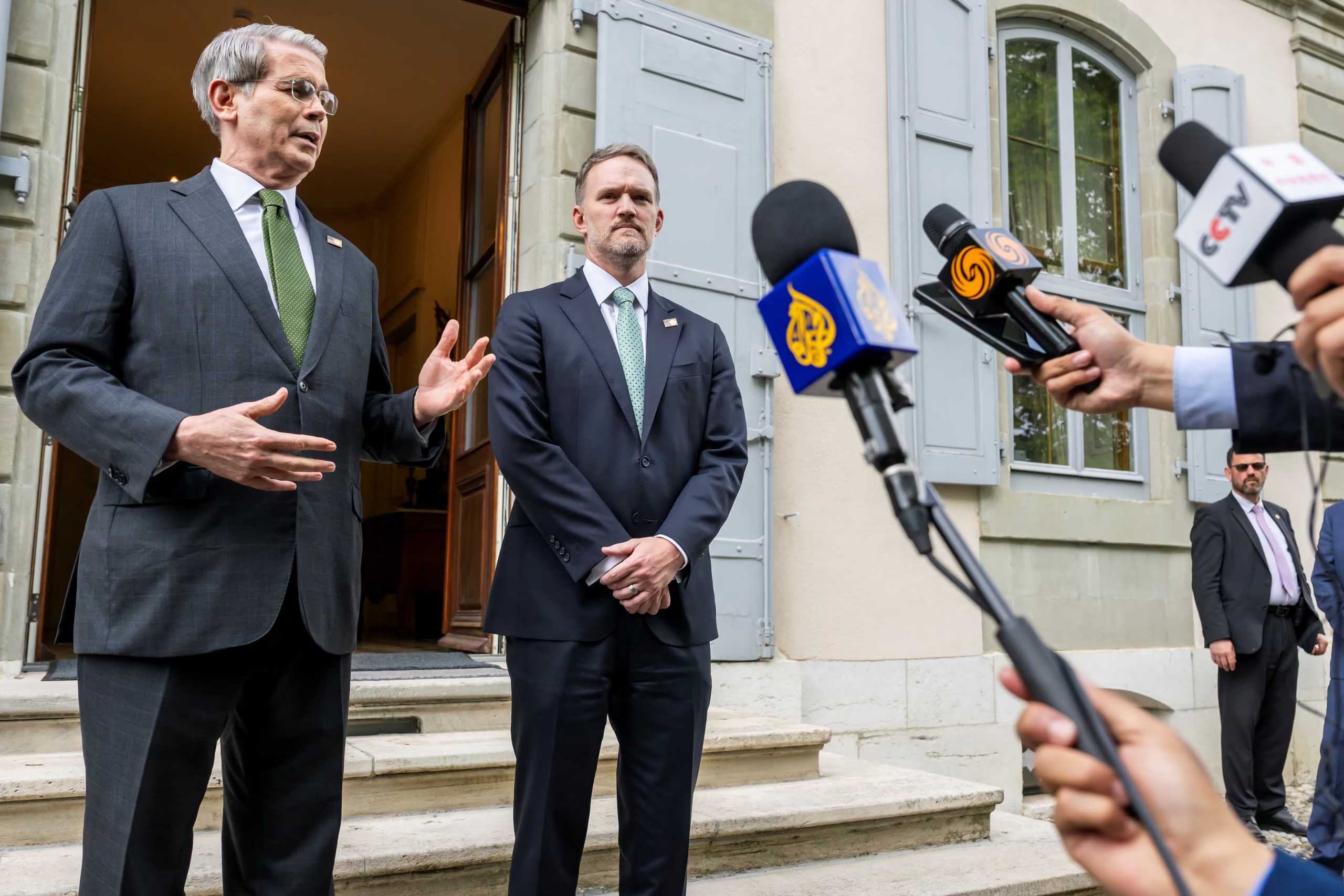
China has firmly rejected allegations from the U.S. claiming it breached the terms of the Geneva trade agreement, instead accusing Washington of violating the pact and undermining the fragile consensus. This development signals a growing rift between the world’s two largest economies as trade tensions escalate once again.
The accusations come in the wake of a recent Geneva meeting between U.S. Treasury Secretary Scott Bessent and Chinese counterpart He Lifeng, which had initially led to a 90-day suspension of most tariffs between the two nations. Despite this progress, the Trump administration has since ramped up restrictions on technology exports, particularly semiconductor design software and key chemicals, while also tightening visa rules for Chinese students. Beijing has condemned these moves, asserting that they “seriously undermine” the agreement.
A spokesperson for China’s commerce ministry warned that if the U.S. continues with such actions, China will take necessary steps to protect its interests. Contrary to U.S. expectations, China has maintained tight control over rare earth minerals exports, highlighting efforts to combat illegal mining and smuggling of critical minerals within its borders.
Experts suggest that Beijing remains confident and unyielding in negotiations. Stephen Olson, a senior fellow at Singapore’s Yusof Ishak Institute, remarked, “China views any agreement with the U.S. as only a temporary measure rather than a long-term solution.” He further noted that China’s stance reflects its broader strategy to avoid capitulating under pressure.
The Chinese commerce ministry also criticized Washington’s approach as “unilateral provocations” that increase instability in bilateral economic relations. President Donald Trump publicly accused China via social media of violating their preliminary trade deal, particularly frustrated with Beijing’s perceived slow progress on easing rare earth export restrictions.
Bert Hofman, professor at the National University of Singapore, interpreted Trump’s comments as a reaction to China’s cautious approach, which conflicts with expectations set by the Geneva talks. Meanwhile, Chinese officials maintain that they have fully upheld the agreement by suspending certain tariffs reciprocally.
The deadlock in trade negotiations has prompted calls for direct communication between the two leaders. Treasury Secretary Bessent indicated that a phone call between Trump and Xi Jinping might be necessary to break the stalemate. However, analysts believe such a conversation is unlikely to occur soon due to fundamental differences in diplomatic protocol: while the U.S. prefers leaders to negotiate early, China traditionally favors lower-level officials resolving most issues before direct leader engagement.
Amid trade disagreements, tensions have expanded into broader geopolitical concerns. At the Shangri-La Dialogue defense summit in Singapore, U.S. Pentagon Chief Pete Hegseth warned of an “imminent” threat posed by China’s increasing military assertiveness in the Indo-Pacific region, urging allied nations to boost their defense capabilities.
Notably absent from the summit was China’s defense minister, breaking a tradition of consistent high-level attendance since 2019. In response to Hegseth’s remarks, the Chinese embassy in Singapore condemned the U.S. for fomenting regional instability, while the Chinese defense ministry accused Washington of perpetuating a “cold-war mentality” and violating China’s sovereignty.
As diplomatic and economic tensions deepen, the path toward meaningful resolution between the U.S. and China appears increasingly complex, with each side firmly entrenched in its position.
