

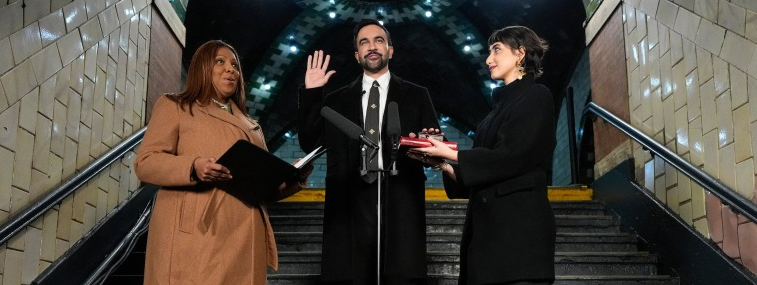
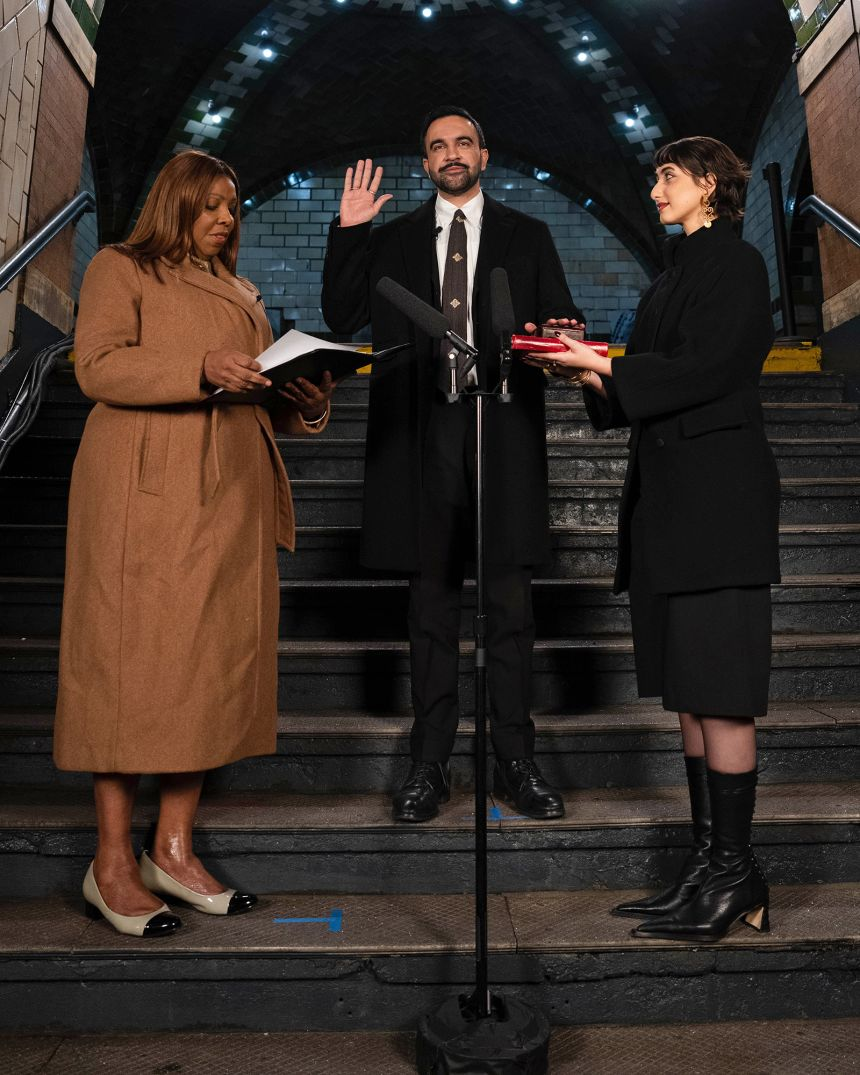
When Zohran Mamdani was sworn in as New York City’s mayor just after midnight on the first day of the year, the moment signaled political change. But standing beside him, his wife Rama Duwaji quietly announced something else as well: a generational shift in how power, identity, and style intersect in public life.
Duwaji, an artist and illustrator, approached the inauguration not with the ceremonial stiffness often associated with political spouses, but with an ease that felt unmistakably contemporary. Her outfit—oversized tailored shorts, sculptural earrings, and chunky boots—looked less like traditional political attire and more like something pulled from the wardrobe of a downtown creative heading to an opening in Tribeca or a late dinner in Brooklyn.
Styled by Gabriella Karefa-Johnson, Duwaji’s inauguration look balanced intentionality with restraint. She wore a vintage black coat paired with culotte-style shorts, grounding the silhouette in structure while allowing for experimentation. Her boots came from Miista, a label known for architectural footwear favored by fashion-forward celebrities, while her chandelier-style earrings—on loan from New York Vintage—added a bold, sculptural accent.
Importantly, nothing about the look felt costume-like. That may be its most political quality. Duwaji dressed as herself, continuing a visual language she has used throughout the campaign and election season. In doing so, she reinforced an idea increasingly embraced by younger voters: authenticity matters, even—or especially—on ceremonial stages.
After the swearing-in, Duwaji changed into a second look to greet the public, opting for a chocolate-brown A-line coat with a funnel neck by Cynthia Merhej, whose label Renaissance Renaissance reflects a similarly experimental ethos. She swapped her gold earrings for a sculptural silver pair shaped like a curved tusk, leaning further into the idea of fashion as personal expression rather than political uniform.
Taken together, the two looks captured a specific aesthetic familiar to many young, urban New Yorkers. It is a style rooted in vintage shopping, independent designers, and a largely neutral palette punctuated by statement accessories. It favors individuality over polish and confidence over conformity. Duwaji’s fashion choices mirror how a generation accustomed to blurred lines between work, art, and activism presents itself to the world.
Her appearance also stood in quiet contrast to the wardrobes of political spouses past. Gone were the predictable dresses and cautious tailoring meant to offend no one. In their place was something more reflective of the city she now represents—layered, multicultural, and unapologetically modern.
Duwaji has previously worn designs by independent Palestinian creators and New York–based labels, reinforcing her commitment to fashion as both craft and statement. These choices align with the broader message of the incoming administration: change does not require abandoning identity. It requires owning it.
At a moment when public trust in institutions feels fragile, symbolism carries weight. Duwaji’s style does not promise solutions, but it offers something equally resonant—a reminder that leadership can look different, feel human, and still command the room. In a city defined by reinvention, that may be exactly the point.
