

[ad_1]
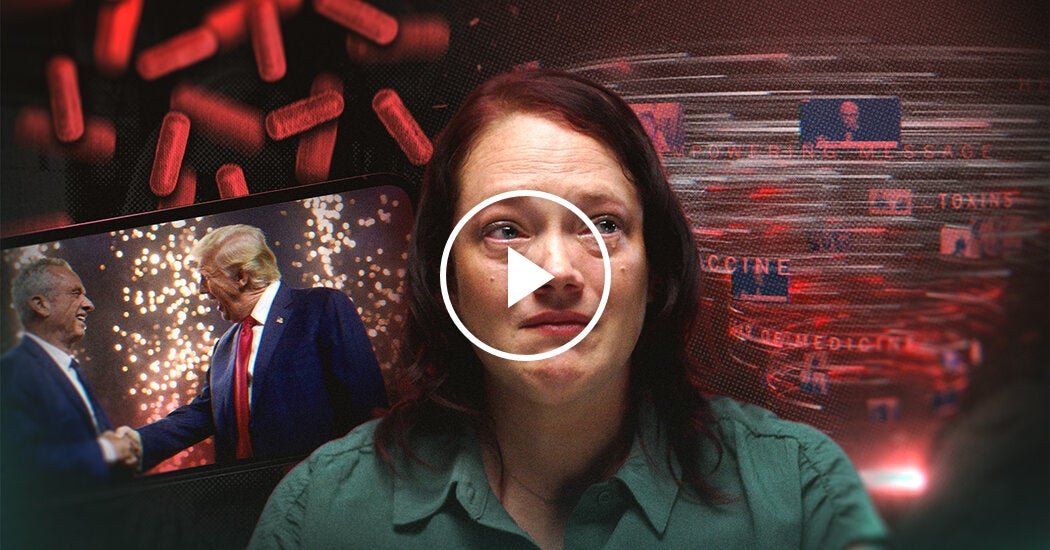
[SLICING, WHIRRING] If you’ve ever detoxed on celery juice, searched a nutrition label for artificial food dyes or stopped eating seed oils — “Seed oils.” “Seed oils.” “Seed oils.” you may have already fallen for their ideas. Scroll a little further, and some of them might convince you to become an anti-vaxxer — “Never taking that friggin’ vaccine.” or to reject medicine entirely. “There’s not a single drug on the planet that cures a disease.” “I don’t even take an Advil.” OK, I know that seems like a pretty big leap. How can drinking celery juice lead you to become an anti-vaxxer? But get this. There’s a tight-knit group of wellness influencers who have been radicalizing their followers into believing the health care system is intentionally making people sick. “These industries are doing everything in their power to create and maintain chronic disease at the highest level.” Only 40 percent of people say they trust the health care system, and there’s obviously a lot wrong with it. But these influencers frequently exploit the distrust, often using wellness content as a Trojan horse for conspiracy theories. “I don’t think I’ll take an mRNA vaccine ever.” And I’m not just talking about vaccines. Many in this group question whether we even need evidence-based medicine at all. “The biggest thing that’s causing people to be sick are medications that are actually recommended from doctors today.” “The medical establishment is killing more people than it ever has in history.” And now these influencers have parlayed their massive social media following into a powerful political movement. You’ve probably heard of it. It’s called “Make America Healthy Again.” “Make America Healthy Again.” “Make America Healthy Again.” Our team at New York Times Opinion set out to reconstruct the journey people take to falling for the conspiracy theories spread by many MAHA influencers. So we interviewed some of their former followers, retracing their stories step by step through the videos and podcasts they consumed. Our analysis focused on a core group of 38 people and organizations. Many are close associates, hosting one another on their podcasts and now shaping government policy. These aren’t fringe figures. Their videos have been viewed more than four and a half billion times in total. Not everything these influencers say is dangerous, and it’s often contradictory. So we used A.I. to find patterns in about 12,000 videos and podcasts. We found that this content can act like a funnel, turning health-conscious people against health care. I’m going to take you through this funnel to show how these conspiracy theories could pull in even someone like me or you. [MUSIC PLAYING] Your introduction to these influencers might begin with something we all try searching for. “I was looking for ways to optimize my health.” “I dove into the healthy food world.” Much of the content posted by MAHA influencers isn’t dark or conspiratorial. “A mission to help women around the world take back control of their health.” “I thought they were confident and professional.” Look at them. They’re paragons of health. “This person that looks the way that I want to look is saying that it works, so let’s give it a try.” You might be surprised by how many of the products these influencers own or promote are already in your pantry. “I’m drinking my raw milk. It’s absolutely delicious.” That’s how they start to win your trust. “I just want to help you. Like, I’m just here to help people.” “To help people around the world reclaim their health.” Then the influencers we analyzed will often barrage you with statistics. “38 percent of teenagers are prediabetic.” “1.7 million Americans are dying every year of chronic disease.” “Increased rates of depression, anxiety, suicide.” And for all these ailments, these influencers usually blame a boogeyman. “Toxins.” “The toxins.” “Monumental stew of new toxins.” What are toxins? Could be just about anything. “Artificial food dyes.” “Soybean oil, canola oil.” “What the [EXPLETIVE] is fluoride doing in the water?” “It’s a neurotoxin.” The people we spoke to said the hunt for toxins fueled an obsession, continually leading them back to these influencers for more and more health advice. “I started cutting out dairy.” “Dairy.” “And gluten.” “Gluten.” “Detoxing everything in your home.” “Let me show you my favorite nontoxic hack for washing my clothes.” Here’s the thing: Toxins are just a scapegoat, distracting from the real causes of America’s health problems, like poverty, lack of access to health care and nutritious food. Rather than meaningfully address those issues, these influencers push their expensive detoxification products. “How can we detoxify our bodies from these insidious particles?” You see, MAHA influencers conjure a scary image of a world full of toxins and juxtapose it against their curated image of vitality. In other words, you’re sick, but they are not. As a result, you may start to believe these influencers have all the answers, not your doctor. “I learned virtually nothing at Stanford medical school.” “I feel like I’m pretty much an expert on parsing medical information.” “I remember I went to the doctor’s one time, and she said: Well, you know, anxiety does cause an anxious tummy. I was looking for action steps, and online I was getting them. And so I decided for myself, to put more money into people who weren’t in the mainstream health care.” So by this point, let’s say you’ve adopted some of the wellness practices promoted by MAHA influencers. What’s so wrong about that? Well, that’s just the beginning of the funnel. “Really be vigilant about looking at labels.” “I really even developed a fear of cancer.” “Cancer.” “Cancer.” “Cancer.” “And it was so extreme, I wouldn’t eat because of it.” “I hate the word ‘moderation,’ because I don’t think there’s any reason to, like, have poison in moderation.” Some of the people we spoke to said this extreme rigidity about food contributed to them developing an eating disorder. “I became very health- anxious, not even just health- conscious. It became like a health anxiety. It was what I thought about 24/7.” “You just become almost Howard Hughes-ian. You know too much.” “I think I would have told you then that I was feeling better, but I don’t think I was. I think I was feeling more in control. There was content that seemed a little far-fetched.” “We will investigate electromagnetic radiation, the childhood vaccine schedule.” “But then the more that I would cut things out of my diet and not see improvements, then I thought, well, maybe it is vaccines. OK, well, maybe these people are on to something.” Fear is a powerful tool for wearing down skepticism. “I had a tailored ad — the truth about vaccines. Being a new mom and just scared of everything ever, I think we paid $200 for it.” “My goal is to present the truth so that you can make an educated decision for you and your own family.” “And then there was R.F.K. Jr.” “I’m pro-vaccine. I had all six of my kids vaccinated.” “He would say: I’m not against vaccines. My kids are fully vaccinated.” “Autism, SIDS, narcolepsy. There’s science out there that indicates that those illnesses are being caused by vaccine association.” “That really made me anti-vaccine. I thought: If my daughter got vaccinated, she would die in her sleep that night.” “I’m pro-safety. I am not anti-vaccine.” R.F.K. Jr. makes his message sound uncontroversial, but the organization he founded is much more overt. “Vaccines have destroyed millions and millions of lives.” “I will never take another vaccine as long as I live.” He never has to actually say it himself to let you know what he really thinks. “They’re not safe. They don’t keep you from getting sick. It’s really not possible to create a safer vaccine.” Much of this content preys on people’s vulnerabilities. “My mom got diagnosed with colon cancer. So I started looking online. And if it says ‘I cured my cancer this way,’ why in the world wouldn’t you click on that?” “I’ve got an approach that will cure well over 95 percent of cancer patients.” “And you only need a little nudge at that point to really go off the deep end.” “You can reverse cancer with the ketogenic diet.” “Don’t take chemo. Your life depends on it to not take it.” The more scared you become of medicine — “Medications, that’s part of a sort of toxin bucket.” The more you’ll seek out these influencers’ alternatives. “Natural ways that you can go about trying to recover your child from autism.” “Dying in a concentration camp or dying from being intoxicated by chemotherapy as opposed to choosing natural paths are the same.” “I remember telling my mom: I think you shouldn’t do chemo.” And if you reject medicine, this is what can happen. “When my baby sister would go online and find something to cure her cancer, there was always a price tag. It was something someone had created without any peer review, without any evidence to make money off of desperate and fearful people. I would say she spent well over $50,000.” Crystal’s sister got cancer several years ago, before this movement started calling itself MAHA. She decided against chemotherapy, instead opting for many of the same all-natural treatments these influencers continue to promote today. “It was really difficult to watch it spread and get worse and worse and her not to change course. I asked her: Are you going to have surgery now? And she lost it. Like, she exploded at me and said that I wasn’t supportive. She just went downhill really fast. [SIGHS] One second. I’m pretty sure she knew she was going to die. She said goodbye to her son. Her husband had curled up on the bed next to her and — sorry. [SNIFFLES]” After two years of alternative treatments, Crystal’s sister finally tried chemotherapy, but it was too late. Just a couple of weeks later, she died of cancer at the age of 33. People who use alternative instead of conventional treatments for cancer are up to five times more likely to die within the first five years of being diagnosed, and people refusing to get vaccinated has caused a resurgence in infectious diseases. “2025 is now the worst year for measles in more than three decades.” “The second child has now died from the measles.” All the while, these influencers profit. Just about every MAHA influencer sells something or another. Calley Means runs an online marketplace for alt health products. He steers money that’s supposed to be spent on health care into his business. He now works in the Trump administration. His sister, Casey Means, sells health tech wearables, which can allow people to obsessively track what they eat. She’s been nominated surgeon general. And of course, R.F.K. Jr. has made millions through his anti-vaccine organization, lawsuits against pharmaceutical companies and book deals. Wellness is a $460 billion industry. These influencers criticize Big Pharma, but they’re just Big Wellness, using their newfound political power to dismantle the health care system from the inside — “Removing an expert panel of vaccine advisers.” “More than $2 billion in research grants have been canceled.” While working to write regulations that benefit their own businesses. You see, the MAHA movement is not going to fix the health care system because its leaders profit by making people distrust health care. “A sick care system.” “A sick care system.” “That is not health care. That is sick care.” That phrase, ‘sick care,’ is the conspiracy theory at the core of the MAHA movement. It’s about much more than just distrusting medicine. “The U.S. health care system is an existential threat to our country. They don’t want to kill our children. They just want to keep them sick.” Our team was able to identify 749 videos or podcasts featuring this group of MAHA influencers that claim the health care system knowingly harms people. “When do we get to put the corrupt doctors in jail?” “We do need to start holding people accountable.” Like this video, in which doctors are made out to be grim reapers. “It was easy to be convinced that doctors do not have your best interest in mind.” “They are programmed to sell you something that they’re profiting off of.” “Doctors, they like money and power. They don’t really care if kids die.” And that’s how these MAHA influencers can lead you from trying a harmless health tip to turning against all health care. Wellness to conspiracy theory. It’s a coup of our health care system. So how do we fix this? For one, the U.S. should hold supplements to similar regulatory standards as it does pharmaceuticals. This would significantly limit the ability to profit off of unproven products. Secondly, listen to what Steve has to say about going with his mom to see her oncologist. “He was open to hearing about what I had found out about some of these alternative therapies. He didn’t shame me. He didn’t say: That’s ridiculous. He listened. And I think then it also dropped some of my guard down. We must have been in there for at least an hour and a half. Here was not this big, scary guy that seemed like he was just in the pockets of the pharmaceutical companies, but somebody genuinely interested in helping my mom. Leaving there, Mom decided to go ahead and do chemotherapy. Thankfully, our story has a happy ending. She’s been in remission. Her screenings have been clear so far.” MAHA influencers feed off existing problems with health care, like big medical bills, rushed appointments and complex insurance schemes. The U.S. needs to make health care more accessible by increasing investment in public health agencies and giving doctors more time to spend with their patients so that Steve’s experience becomes the norm. Unfortunately, none of this is likely to happen in this administration. But there is something we can all do right now. “If you have anti-vaxx people in your life, they just need you to acknowledge that they are worried and that they care about their kid. It takes their defensiveness down 100 notches.” Heather slowly opened up to the possibility that the benefits of vaccines outweigh any potential side effects. “Today I refer to myself as an anxious pro-vaxxer.” She now runs an organization that helps vaccine-hesitant parents overcome their fears. Anna’s eating disorder got so bad that she eventually returned to the health care system, where she finally found the help she needed. “So I tried to have compassion for people now that have these extreme beliefs, because when you are feeling scared or anxious about something, whether it be about health or politics, it’s easy to fall into conspiracy theories. And I think that if we can just remember that, then maybe we won’t feel so much hatred.” One of the lessons I learned in my reporting is that the people in our lives who reject vaccines or medicine likely came to these beliefs with good intentions, even if the influencers guiding them did not. So when we dismiss our loved ones as crazy, that just pushes them away. “I don’t think we’re so far apart, really, when we get down to it. We all want to be healthy. We want our loved ones to be healthy. We can start there.” [MUSIC PLAYING]
[ad_2]
Source link
