

[ad_1]
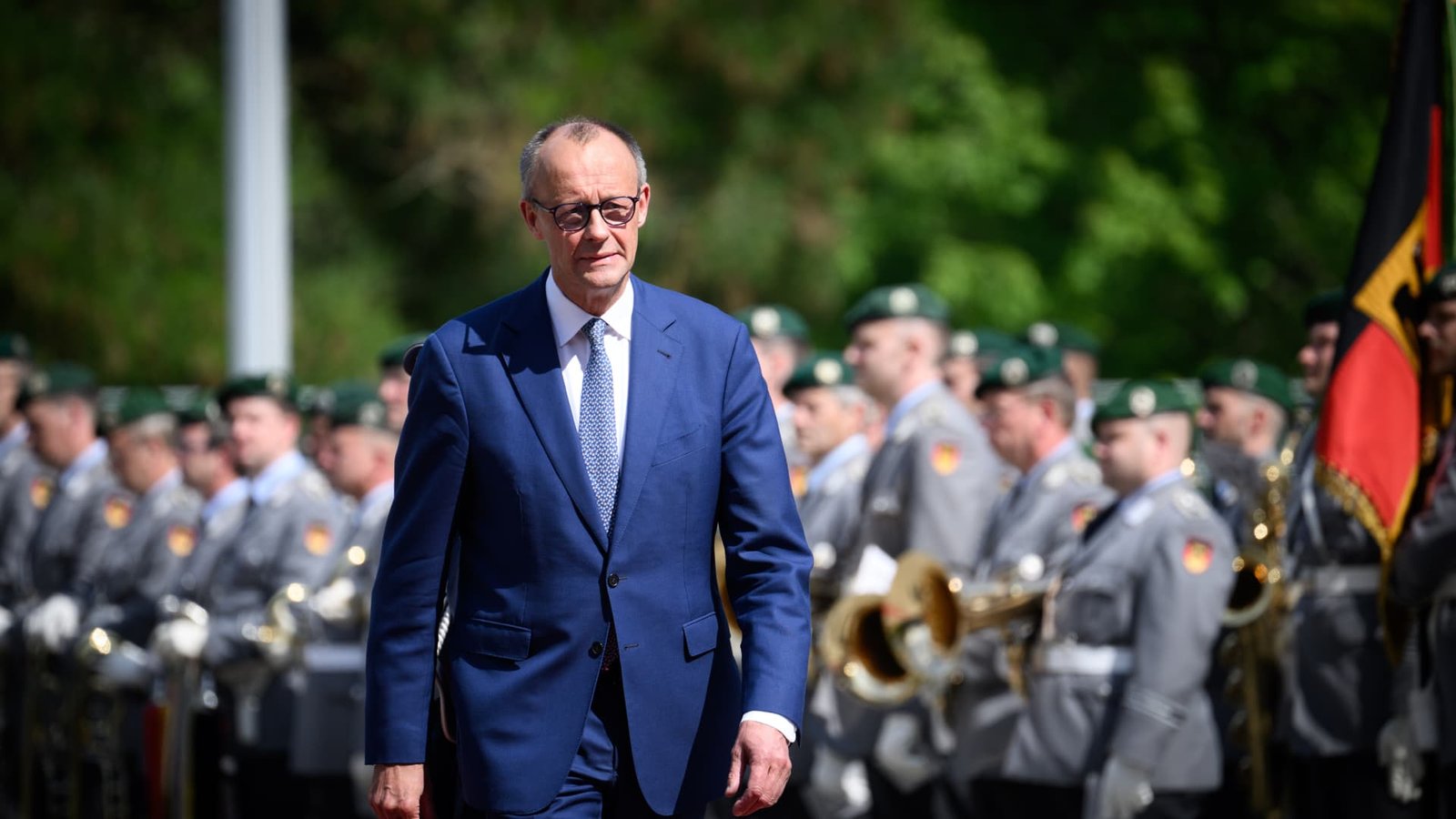
Federal Chancellor Friedrich Merz (CDU) walks past Bundeswehr soldiers with military honors in front of the Federal Chancellery before welcoming the Prime Minister of Denmark.
Bernd von Jutrczenka | Picture Alliance | Getty Images
Tax hikes and soaring debt might be Germany’s new reality, as NATO allies are set to soon face a higher defense spending target.
The country in 2024 spent around 2% of its gross domestic product (GDP) on defense, coming in at over 90 billion euros ($104 billion), according to a NATO estimate. While that expenditure is in line with the existing NATO target, it falls short of the 5% spending goal members of the military alliance have now reportedly agreed on.
Under the new rules, members would be expected to allocate 3.5% of GDP to classic defense spending and 1.5% to broader related matters such as infrastructure and cyber security.
The U.S.-led push for more defense spending has been highly contested, with some NATO members saying they would struggle to assign more funds to such expenditures, while others have been supportive. While Germany has said that it backed the proposal by U.S. President Donald Trump’s, questions linger over whether a 5% target is truly feasible for Europe’s largest economy.
The financials
Jumping from a 2% GDP expenditure to 5% would see Germany spend additional tens of billions of euros on defense each year, with Chancellor Friedrich Merz saying earlier this year that 1% of the country’s GDP would represent around 45 billion euros.
These additional expenses will likely have to be financed by loans, Hubertus Bardt, managing director of economic institute IW Koeln, told CNBC.
“Despite this, such an increase will lead to notable distribution conflicts in the country’s annual budget,” he said, according to a CNBC translation. He added that, on top of loans, the Berlin administration would likely also have to hold discussions about implementing funding cuts elsewhere — along with tax increases.
Emilie Hoeslinger, a researcher at the ifo institute, meanwhile pointed to Germany’s recent fiscal U-turn. Berlin’s new rules mean that defense expenditures above a certain threshold are exempt from Germany’s so-called debt brake, which limits how much debt the government can take on and dictates the size of the federal government’s structural budget deficit. Germany also approved a 500 billion euro special infrastructure fund.
“Financing defense expenditures through additional debt gives the government more leeway in the short term,” she said according to a CNBC translation. “But the increased need for debt will lead to higher interest costs in the medium-term, which will weigh on the federal budget,” she said.
Bardt echoed these concerns.
“A complete financing through loans is almost impossible long-term,” he said.
Another potential issue that experts have flagged in discussions around higher defense spending are the European Union’s fiscal rules, which could get in the way of the bloc’s members taking on more debt.
The rules can, however, be temporarily suspended under exceptional circumstances, and some countries including Germany have requested such a reprieve on defense and security grounds.
Is 5% feasible?
Germany could “easily” implement a 5% GDP defense target in the short term, but would struggle in the long run, according to Jens Boysen-Hogrefe, senior economist at the Kiel Institute for the World Economy.
“Medium-term, [the 5% spending target could be met] with certain challenges, long-term it would need a substantial reform of public budgets,” he said according to a CNBC translation. He added that the EU is unlikely to offer deep resistance on the matter, and that eventually the German government should be able to counter any pressures by adapting their annual budgets.
Nevertheless, “it will be difficult to get such expenses underway in a short amount of time. Even the 3.5% [target is] unlikely for the coming year and [for] 2027,” Boysen-Hogrefe said.
“Historically it would be a very high figure, which can however be reached with enough time — even though this won’t be easy,” IW Koeln’s Brandt said, noting that much would also depend on whether the 1.5% dedicated to wider security related expenses will have to represent new costs.
[ad_2]
Source link
