

[ad_1]
What is the true cost of tariffs?
It’s debatable — not only because of political biases, but also because it’s far from straightforward to calculate just how much of the levies consumers end up paying.
Even so, it’s possible to estimate how much the price of common items could increase under President Donald Trump‘s various tariff proposals. For products like clothing imported from China and Vietnam, U.S. shoppers could have to pay a lot more.
To illustrate, retail consultancy group AlixPartners created pricing models exclusively for CNBC, looking at the price of a men’s sweater and men’s shoes made in both China and Vietnam before and after Trump’s April 2 “reciprocal” tariff announcement. The estimate assumes the retailer is maintaining its previous profitability levels, and using no cost mitigation strategies but rather passing along the tariffs to shoppers in the form of higher prices.
Under a current 30% tariff, the price of a men’s cotton sweater and a pair of men’s shoes made in China would both rise about 19%, according to AlixPartners. If Trump implemented the currently suspended 145% tariff on imports from China, the price of those same sweaters or shoes would spike roughly 90%.
Using a current 10% tariff on goods from Vietnam, the price of a sweater and shoes would both rise about 8%. But under the now paused 46% levy Trump previously proposed, the price of those items would rise roughly 35% each.
The models won’t capture exactly how tariffs will affect consumers. Still, they underscore that the levies, even at their current levels, could take a major toll on U.S. households.
Shoppers may not see price hikes that large for multiple reasons. Most large retailers are using various strategies to offset as much of the cost of the tariffs as possible: Target CEO Brian Cornell, for instance, told reporters raising prices would be the company’s last option.
Final tariff rates could also end up lower than those used in the models.
Retailers usually don’t want to raise prices, because it dampens demand. But they also have a fiduciary duty to shareholders to remain profitable. At the tariff levels Trump announced on April 2 on about 60 U.S. trading partners, there’s not much room for the nation’s retailers to “eat” the levies — as Trump suggested — when operating profit is around 5%.
Men’s sweater made in China
Customers shop at a GAP Outlet store on May 29, 2025 in Chicago, Illinois.
Scott Olson | Getty Images
AlixPartners calculated the estimated costs by adding up costs like production, duties, tariffs and logistics. Here’s how that breaks down.
Before April 2, a 100% cotton men’s sweater made in China could start at a cost of $6.80 to make. A 41.5% total tariff and duty rate was already in place for that sweater shipped to the U.S., adding $2.82. Then, there’s the cost of logistics and sourcing, which is another 95 cents.
Put together, the total “cost” of making that sweater was $10.57. At a typical gross margin target of 65%, the retail price before April 2 would have been $30.
The graphic below illustrates how both the current tariffs and highest possible duties would affect those costs.
Using the same 65% margin, a consumer would pay a new price of $35.79 under current policy, a 19% increase. With the full 145% tariff in place, the price would balloon to $57.97, or a 93% spike from before April 2 for the same men’s sweater.
Men’s shoes made in Vietnam
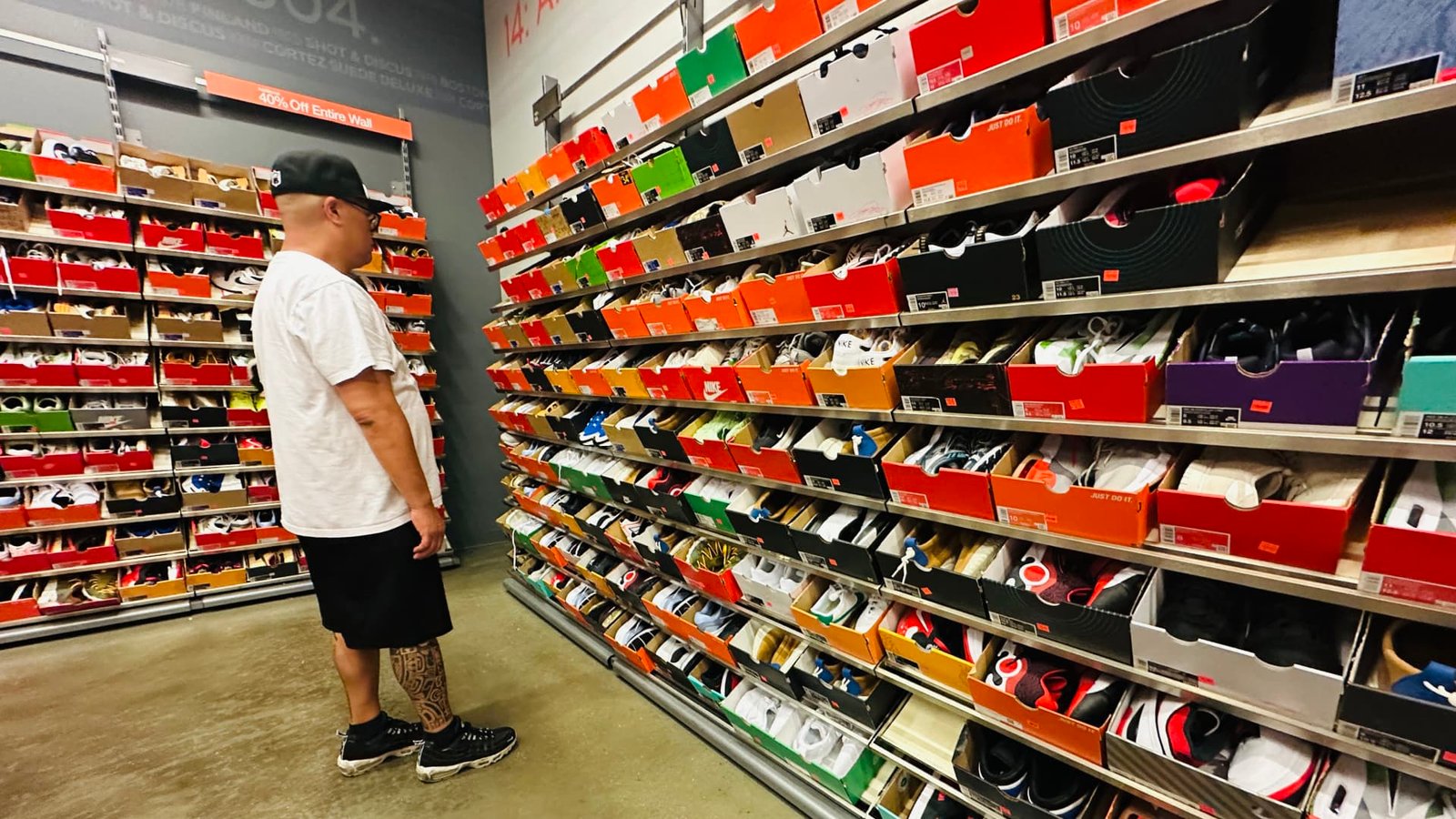
A man shops for shoes at a Nike outlet store in Los Angeles, California on April 10, 2025.
Frederic J. Brown | Afp | Getty Images
While current and proposed tariff levels on Vietnam are not as high as those on China, the duties could still be a major blow to retailers that source a lot of footwear from the country. Nike makes many of its products there and has already said it will raise prices — though it did not blame tariffs for the move.
AlixPartners’ model shows how tariffs could change the price of Vietnam-made shoes if a retailer passed along the full cost.
Before April 2, a pair of men’s shoes made in Vietnam could start at a cost of $29.50 to make. A 20% total duty was already in place for those shoes shipped to the U.S., adding $5.90 to the cost. Then, there’s the cost of logistics and sourcing, which is another $2.36.
Put together, the total “cost” of making that sweater $37.76 At a typical targeted gross margin of 60%, the retail price before liberation day would have been $95.
Now, look what happens when current and proposed tariffs are factored in:
Using the same 60% margin, a shopper would pay $102.42 for the shoes under current policy, an 8% jump. With the highest proposed tariff in place, the new price would be $129.14, or an increase of 36% for the same pair of men’s shoes from before April 2.
How retailers are preventing a worst-case scenario
Regardless of where tariff rates end up, the largest companies aim to deploy some mitigation strategies to cushion the impact on consumer prices.
Retailers may change manufacturing locations to countries with a lower tariff — though that could take years. It’s possible foreign manufacturers can pay some of the tariff cost. Companies may also change the type of products they carry or tweak features to lower the cost. In some cases, retailers may explore other tax efficiencies.
Still, even Walmart — the world’s largest retailer by revenue — warned it may be impossible to absorb the entire tariff cost, even at current levels.
Retail lobby groups warn that even if the full dollar value of tariffs is not passed along in the prices consumers pay for goods, like any economic model, there is still a “cost.”
The Penn Wharton Budget Model illustrates how even when businesses and consumers share the tariff costs, job losses will likely occur as retailers try to cut costs and GDP declines.
Another complicating factor when it comes to deciphering the true cost of tariffs is that large retailers like Walmart, Lowe’s, Target and others have said they may use the “portfolio approach” to pricing. That means they could shift the cost of the tariff to an item where consumers are less likely to notice an increase.
[ad_2]
Source link
